Greaseproof paper sits directly against food, which makes it a food-contact material and, since 2023, a regulated one in much of the country. Two separate questions decide whether a given sheet is fit for the job, and buyers often collapse them into one. The first is performance: does the paper actually stop grease from soaking through under your hottest, oiliest menu item. The second is compliance: is the paper free of the fluorochemicals that a growing list of states now ban in food packaging, and can the supplier show it meets food-contact rules. A sheet can pass one test and fail the other, so it pays to understand both before committing to a print run.
How grease resistance is actually measured
The industry does not grade greaseproof paper by feel, it grades it with the Kit test, standardized as TAPPI T559. The test applies a series of increasingly aggressive oil-and-solvent mixtures to the paper surface, and the paper’s rating is the highest-numbered solution that can sit on it for fifteen seconds without staining through. The scale runs from Kit 1, minimal resistance, to Kit 12, maximum resistance, so a higher number means a tougher grease barrier. The number you need is driven entirely by what the paper will hold. Dry and low-grease items such as bread, rolls, and plain pastries are served fine by roughly Kit 1 to 4. Moderately greasy foods, the sandwiches, burgers, and pizza slices that make up most counter service, generally call for Kit 5 to 7. Fried and high-fat foods such as chicken, wings, fries, and doughnuts push into Kit 7 to 9, with the upper end recommended when food sits in a warming drawer for half an hour. Heavily sauced items or long holding times are where Kit 10 to 12 earns its keep.
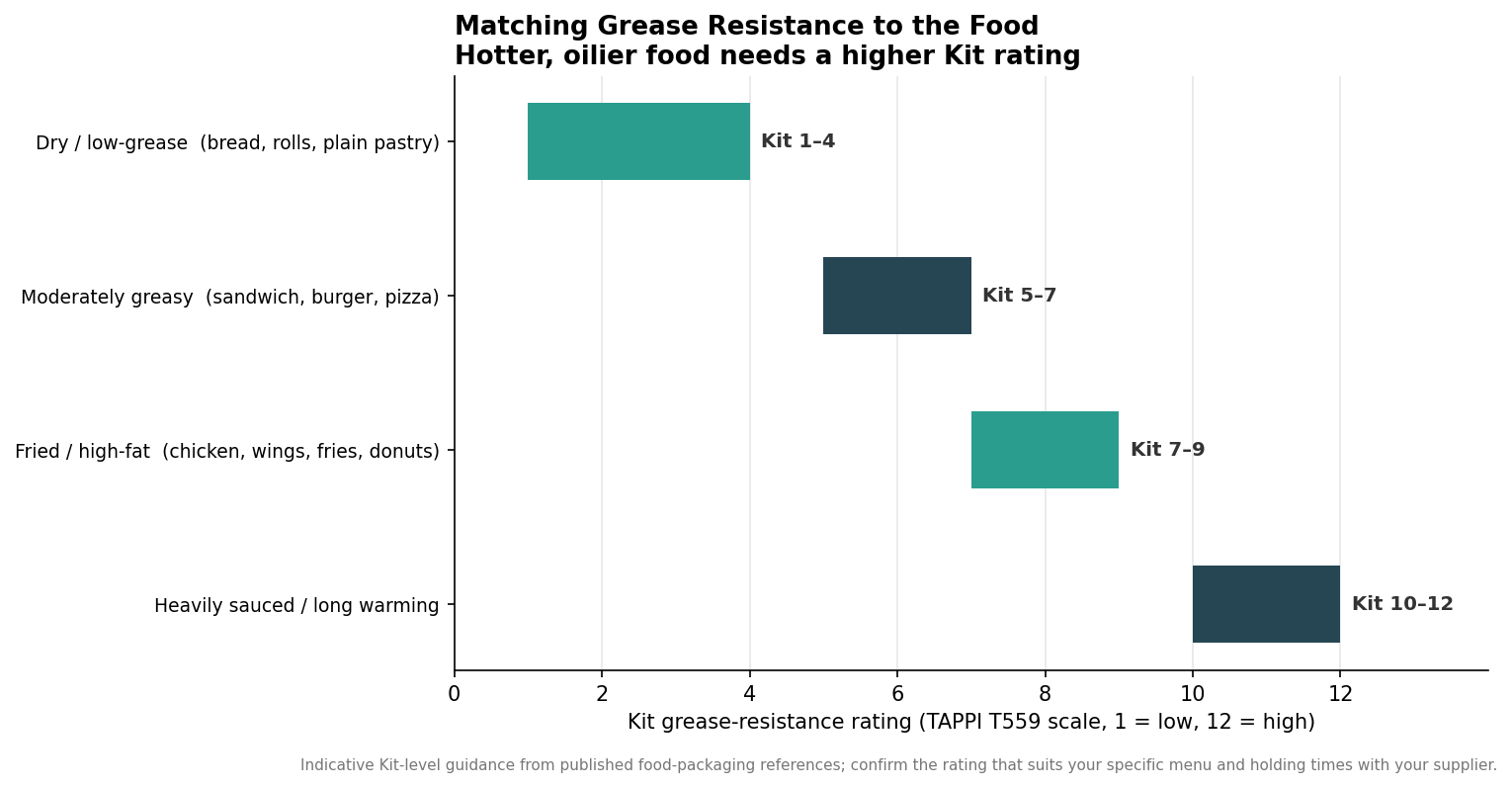
The practical error is to over-spec or under-spec. Buying Kit 12 paper for dry cookies wastes money on a barrier the food will never test, while wrapping fried chicken in a Kit 4 sheet produces exactly the grease-through that stains a customer’s hands and a branded bag. Match the rating to the greasiest thing the paper will actually touch, and account for how long the food sits before it is eaten.
The PFAS shift buyers cannot ignore
For decades, the cheapest way to hit a high Kit rating at low paper weight was to treat the sheet with per- and polyfluoroalkyl substances, the fluorochemicals known as PFAS. They are extremely effective grease barriers, and they are also persistent in the environment and the body, which is why regulators moved against them in food packaging specifically. The change has been rapid. A representative group of a dozen states, including New York, California, and Washington from 2022 and 2023, then Colorado, Maryland, Minnesota, and others through 2024 and 2025, now bans intentionally added PFAS in food packaging, and more have measures pending. At the federal level, manufacturers completed a voluntary phase-out of PFAS-based grease-proofing agents for paper and paperboard food packaging by early 2024, so those treatments are no longer being supplied into the U.S. market.
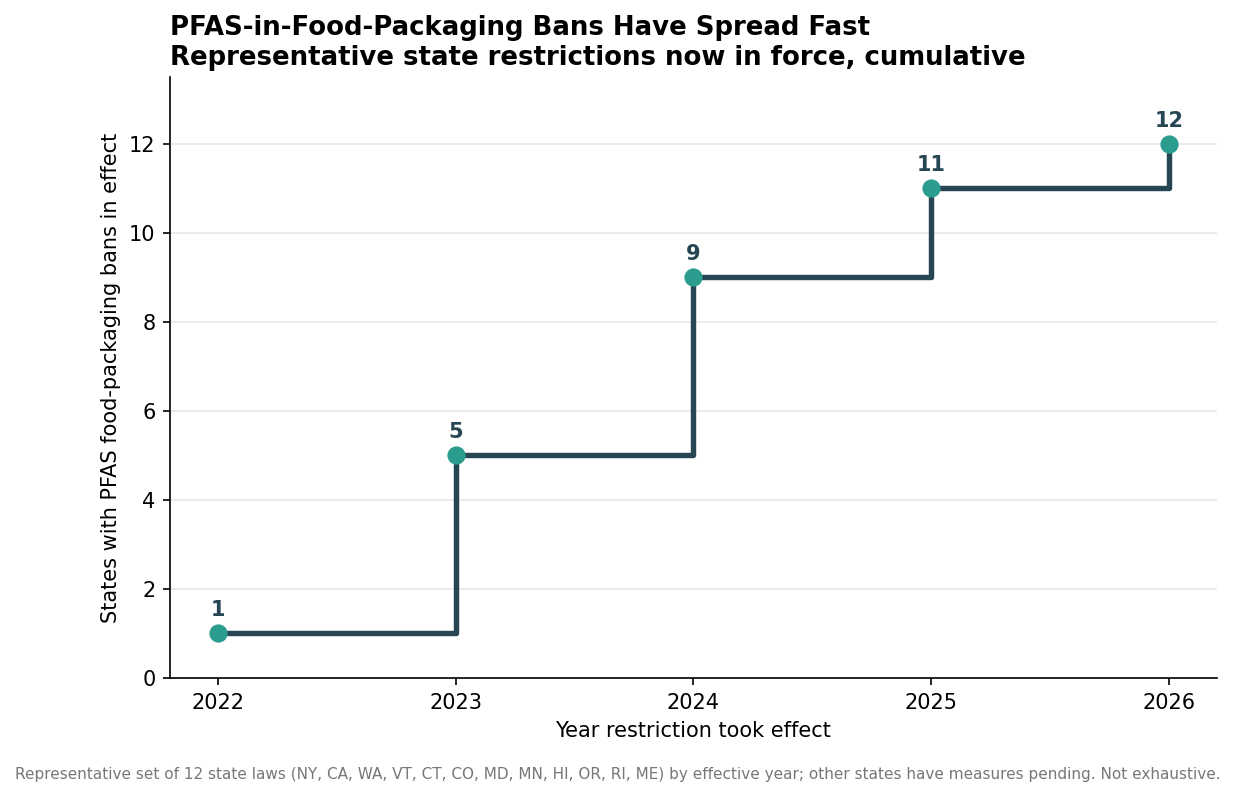
For a brand ordering custom greaseproof paper, the upshot is simple: PFAS-treated grease resistance is on its way out regardless of where you operate, and in many states it is already unlawful. Specifying PFAS-free is no longer a premium green choice, it is the baseline a compliant order has to meet.
How PFAS-free paper still stops grease
Removing PFAS does not mean giving up grease resistance, it means achieving it a different way. The most common route is mechanical: heavily refining and densifying the pulp so the sheet’s fibers pack tightly enough that oil cannot travel through, which is the principle behind traditional glassine and genuine greaseproof papers. The second route is a non-fluorinated barrier coating, such as water-based dispersion coatings, clay, silicone, or a thin poly layer, applied to the food-contact side. Each approach has trade-offs worth knowing. Densified papers keep the sheet fully paper-based and often recyclable or compostable, but very high Kit levels can require heavier stock. Coated papers can reach strong grease and moisture resistance at lighter weights, but a plastic or poly coating can complicate composting and recycling. When you ask a supplier for PFAS-free paper at a given Kit level, ask which method delivers it, because that determines both the feel of the sheet and its end-of-life options.
Food-contact and print compliance
Grease resistance and PFAS status are the headline issues, but a compliant sheet has to clear a few more. The base paper and any coating that touches food fall under the FDA’s food-contact rules for paper components, codified at 21 CFR 176.170, so a reputable supplier should be able to confirm the paper is manufactured to food-contact standards. Printing matters too: custom greaseproof paper should be produced with food-safe, low-migration inks, and good practice keeps heavy ink coverage on the side that does not contact the food wherever the design allows. If you intend to make a compostable claim, that is its own certification rather than a byproduct of being paper, and it typically means meeting a standard such as ASTM D6400 or D6868 and carrying third-party certification; a poly-coated sheet generally will not qualify. None of this requires you to become a materials expert, but it does mean the right questions to ask a supplier are specific: confirm PFAS-free status, state the Kit level your menu needs, request food-contact documentation, and clarify the ink and any compostability claims in writing.
Specifying a compliant order
Put together, a sound spec reads less like a wish and more like a checklist. Start from your greasiest, hottest item and pick the Kit level that survives it through your longest holding time. Require PFAS-free grease resistance as a non-negotiable, and ask whether it is achieved by densified fiber or a named coating so you understand the recycling and composting implications. Confirm the paper meets food-contact requirements and that your artwork will print in food-safe inks. Handling those four points before the press runs is what separates paper that merely looks the part from paper that holds the food, protects the brand, and keeps you on the right side of a fast-moving set of rules.
Leave a Reply