Printing “recyclable” or “compostable” on a deli sheet or basket liner is one of the easiest ways to strengthen a food brand’s green credentials, and one of the easiest ways to make a claim that quietly does not hold up. Whether your custom greaseproof paper can actually be recycled or composted after a customer is done with it is decided almost entirely by two things: the coating on the paper, and how greasy the sheet is when it hits the bin. Get either wrong and the claim on the packaging is, at best, wishful. Here is what is true for each type, and how to specify an order whose environmental label survives a second look.
Why grease is the enemy of recycling
The instinct is that paper equals recyclable, but food packaging breaks that rule. Recycling mills turn paper back into fiber by pulping it in water, and oil does not mix with that process. Food oils, grease, and non-stick coatings cannot be separated from the paper fibers during pulping, and a heavily soiled batch can contaminate the pulp badly enough to ruin an entire run of recycled paper. That is why most municipal recyclers reject visibly greasy paper outright. A clean, unused offcut of genuine greaseproof paper is recyclable like any other paper, but the used sheet that wrapped a burger is not, no matter what the roll it came from was made of.
This is the single most common gap between a printed claim and reality. If your sheets are used for fried food, deli items, or anything oily, “recyclable” describes the paper you shipped, not the paper your customer throws away. For food-contact use, composting is almost always the more honest environmental route than recycling.
Composting is where greaseproof paper can genuinely win
The good news is that the grease which ruins recycling is a non-issue for composting. Commercial composters routinely accept food-soiled paper — pizza boxes, napkins, plates — precisely because their high heat breaks it down and the food residue is just more organic matter. The catch is that only some greaseproof papers are compostable at all, and it comes down to the coating.
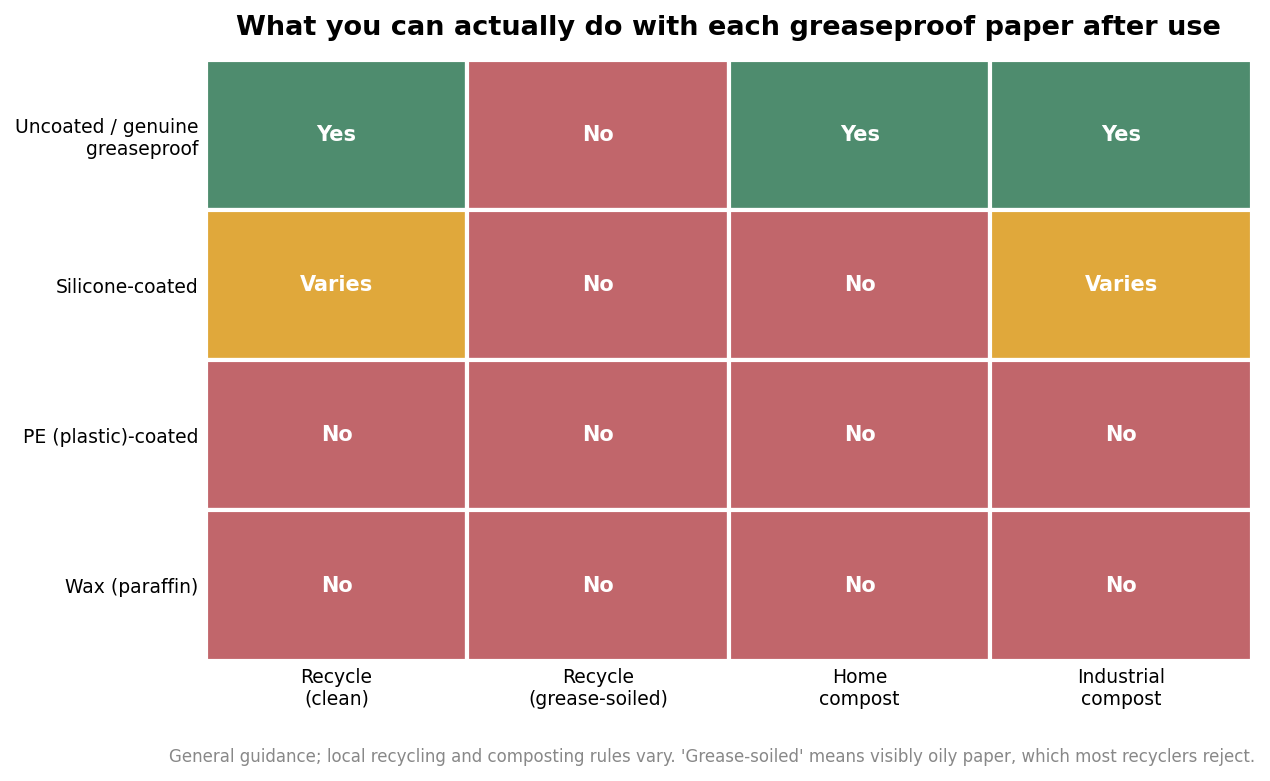
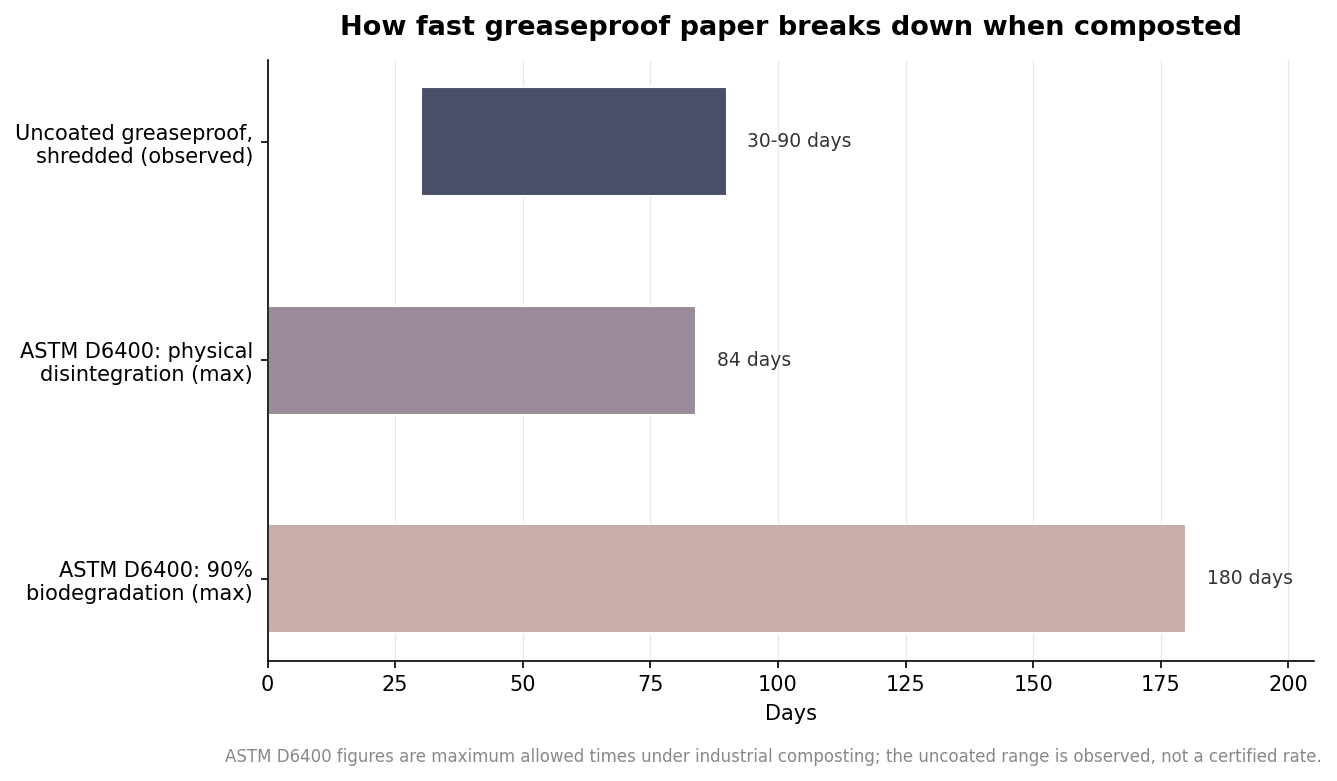
Uncoated or “genuine” greaseproof paper — the kind that resists grease through mechanical refining of the fibers rather than a surface coating — is the strong performer. It is made of natural fibers, and when shredded and mixed into a carbon-rich pile it breaks down in roughly 30 to 90 days under good conditions. That makes it a candidate for both home and industrial composting. Silicone-coated paper is a different story: the silicone is heat-resistant and inorganic, so in a backyard pile the paper vanishes but the silicone remains as micro-residue, which is why it is not considered home compostable and is accepted only by some industrial facilities. PE (plastic)-coated and traditional wax (paraffin) papers fail on both counts — the plastic or petroleum wax neither composts nor survives the recycling pulper — and generally belong in the trash.
What the compostable standards actually require
If you want to print the word “compostable,” it helps to know what a certifier is testing for, because the term is standards-based rather than a general description. In the United States the reference standard for industrial composting is ASTM D6400, and it is stricter than most people assume. To pass, a material must biodegrade at least 90% into carbon dioxide within 180 days, and it must physically disintegrate within about 84 days so that what remains passes through a 2mm sieve with no visible fragments. It must also leave compost that is not toxic to plants and does not carry heavy metals above tight limits.
Two details matter for a buyer. First, ASTM D6400 describes industrial composting, which runs hot — roughly 55 to 70°C — not the cooler, slower conditions of a backyard bin, which may take six to twelve months and often never reach the required heat. A separate certification, TÜV Austria’s OK compost HOME, covers home compostability and is the label to look for if you want to claim customers can compost the sheet at home. Second, the claim needs a certifier: ASTM writes the test, and an organization such as the Biodegradable Products Institute (BPI) verifies that a specific product passes and issues the certification, with re-certification typically every three years. “Compostable” without one of these certifications behind it is a term you should avoid on printed packaging.
Specifying an order whose green claim holds up
The practical path is to decide the claim first, then let it dictate the material. If you want to print compostable, order uncoated genuine greaseproof and ask your supplier which certification it carries — BPI or ASTM D6400 for industrial, OK compost HOME for home — and match your printed wording to that exact scope rather than a vague “eco” label. If your sheets need a moisture or grease barrier stronger than uncoated paper provides, a compostable bio-coating such as PLA can preserve the claim where a PE coating would destroy it, so specify the coating chemistry explicitly rather than accepting “coated” at face value. Confirm that your inks are suitable for food contact and compostable systems, since a heavy metallic or non-approved ink can disqualify an otherwise compostable sheet.
And keep the recycling language honest. Because your paper will usually be used with oily food, avoid a blanket “recyclable” claim and lean on the compostable message, which is both truer and more useful to the customer standing over the bin. The numbers here are indicative and depend on local facilities and conditions, so the safest wording points customers to “where accepted” composting rather than promising an outcome your supply chain cannot guarantee. Choose the coating to match the claim, back the claim with a real certification, and your custom greaseproof paper can carry an environmental message that stands up.
Leave a Reply