Two shops can order the exact same custom greaseproof sheet — same 40 gsm stock, same 12″ × 12″ cut, same one-color logo — and pay wildly different prices, simply because one ran it digitally and the other ran it flexo. The print method is the single biggest lever on what a run costs and how fast it ships, and it is the one decision most buyers never actually make on purpose. This guide walks through the three methods you will be quoted on — digital, flexographic, and offset — and shows where each one wins so you can match the method to the job instead of taking whatever the supplier defaults to.
The three methods, and what actually separates them
Digital printing puts your artwork straight onto the paper with no physical plates, the same way a large-format office press would. Because there is nothing to tool up, setup cost is effectively zero and you can economically print a few hundred sheets. It handles full-color artwork, photographs, and gradients without extra charges, and it lets you change the design between runs at no penalty. The trade-off is the per-sheet rate: digital stays relatively flat as quantity climbs, so it never gets dramatically cheaper at scale.
Flexographic printing — flexo — transfers ink from a raised, flexible plate, one plate per color. It is the workhorse of food-paper printing because once the plates are made, the press runs fast and the ink cost per sheet is tiny. Flexo uses fast-drying, water-based food-safe inks formulated so the sheet does not go soggy, which is exactly what you want on a grease-facing surface. The catch is the plates: you pay to make them before a single good sheet comes off the press, and each additional color is another plate.
Offset printing transfers ink from a metal plate to a rubber blanket and then onto the paper. It produces the sharpest fine detail and the most consistent color of the three, which matters for intricate logos or tight brand-color matching. Like flexo it carries real plate and makeready costs, so it only makes financial sense on large runs where that setup is spread across a lot of sheets.
Where the money actually goes
The cost of a printed run has two parts that behave very differently: a fixed setup cost you pay once, and a per-sheet cost you pay on every unit. Digital shifts almost everything into the per-sheet number and charges nothing up front. Flexo and offset load cost into setup and then run cheaply. That single structural difference is why quantity decides the winner.
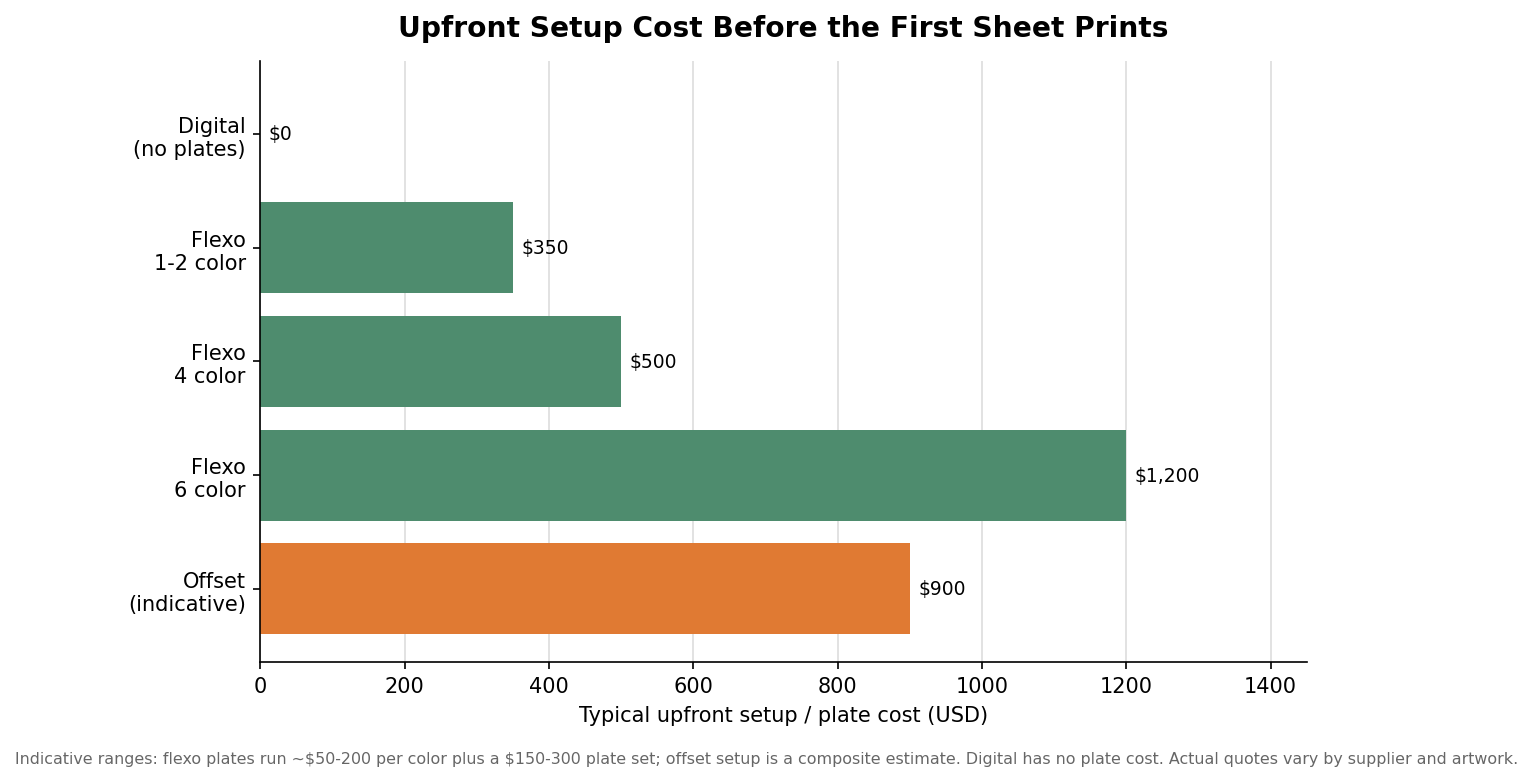
Setup is the part buyers underestimate. On flexo, plates commonly run in the range of roughly $50 to $200 per color, plus a plate-set or imaging fee often in the $150 to $300 band, so a simple one- or two-color job carries a few hundred dollars of tooling before you count paper. A four-color flexo job frequently lands somewhere around the mid-hundreds, and a six-color set can push past $1,000. Digital skips all of it. Offset setup is higher still and varies enough by press and format that any single figure is only a placeholder. The chart below shows the rough shape of that upfront cost by method — treat the numbers as indicative ranges, not quotes.
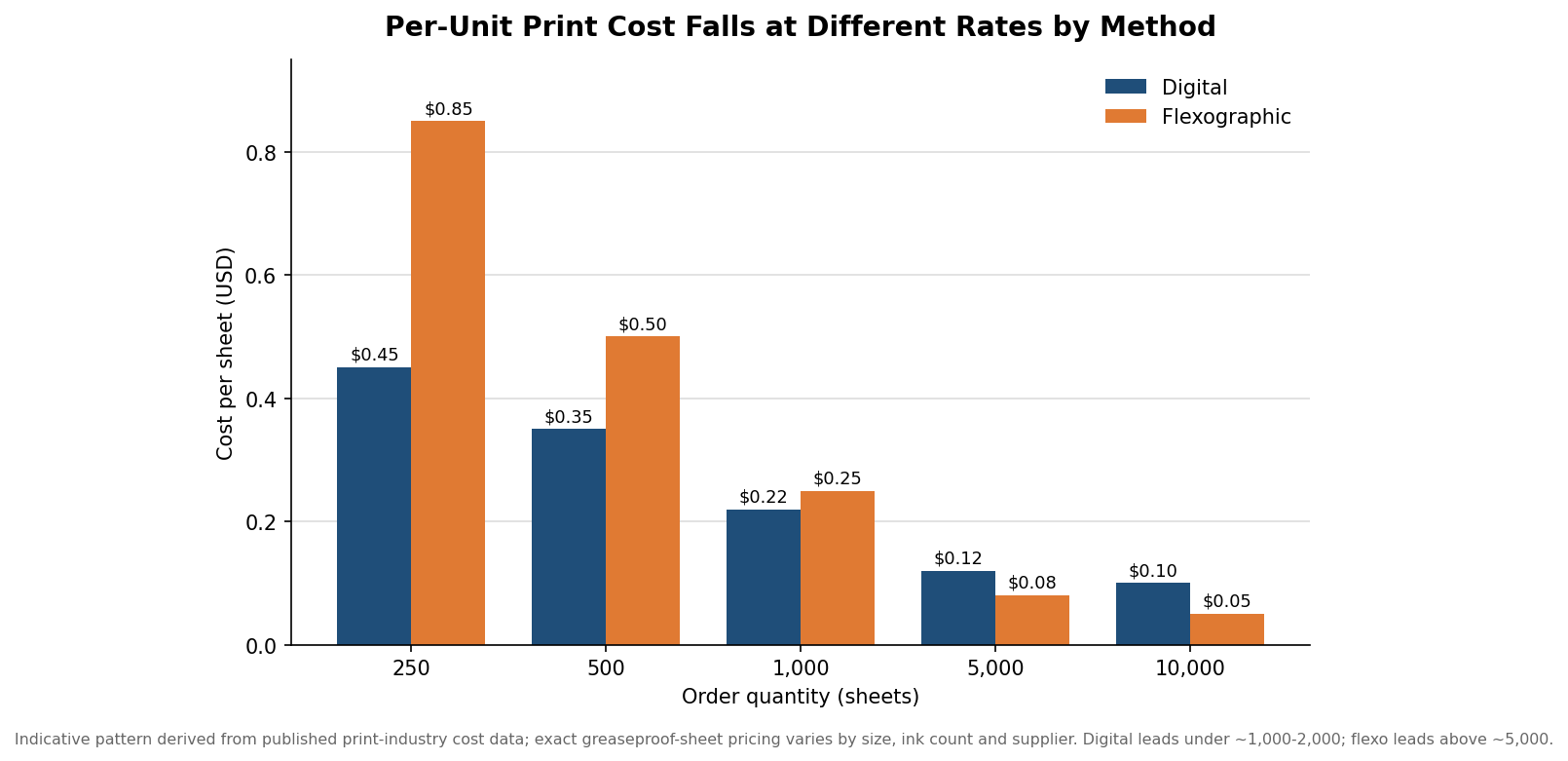
Now layer the per-sheet cost on top. Because flexo runs so cheaply once it is set up, its total cost per sheet keeps falling as the run grows, while digital flattens out. Below a few hundred to a couple thousand sheets, digital is usually cheaper overall because you are not paying for plates. Somewhere in the low thousands the two lines cross, and past roughly 5,000 sheets flexo pulls clearly ahead. The comparison below traces that crossover using published print-cost patterns; the exact dollar figures shift with sheet size and ink count, but the shape holds for greaseproof work.
Minimum order quantities set the floor
Method also dictates how small you are allowed to go. Digital’s plate-free setup means suppliers will often take orders starting around 250 sheets, which is what makes it viable for a new food truck testing a design or a caterer printing for a single event. Flexo minimums typically start higher — commonly around 500 sheets and often more — because a supplier will not tool up plates for a tiny run. Offset minimums are higher again. If you only need a few hundred branded sheets, the decision is effectively made for you: digital is the method that will accept the order at all. If your annual volume is in the tens of thousands, the minimums never bind and you should be choosing on per-sheet cost instead.
Color, detail, and lead time
Match the method to the artwork. A clean one- or two-color logo prints beautifully and cheaply on flexo, and that describes most deli-sheet and basket-liner branding. If your design is full-color, uses photographic imagery, or blends gradients, digital handles it without per-color charges and is usually the practical choice at small to mid volumes. When you need the crispest possible fine lines or an exacting brand-color match across a very large run, offset earns its setup cost.
Speed follows the same logic. Digital’s lack of tooling makes it the fastest to start, with production often quoted in the 3 to 5 business day range, while flexo more typically runs 7 to 10 days once plates are factored in. For custom greaseproof specifically, a common end-to-end window for printing and delivery is around 6 to 8 business days, though anything with new plates, multiple colors, or a large quantity can run longer. If a fixed event date is driving the order, confirm the lead time in writing before you commit, and remember that reordering the same flexo design later is faster and cheaper because the plates already exist.
A simple way to decide
Start with quantity, because it settles most cases on its own. Under about 1,000 sheets, or any time you want to test or frequently change a design, digital almost always wins on both cost and flexibility. Above roughly 5,000 sheets of a stable, simple design, flexo’s cheap per-sheet rate makes it the clear economic pick, and its food-safe, fast-drying inks are purpose-built for grease-facing stock. In the middle — very roughly 1,000 to 5,000 sheets — the two methods are close enough that color count, reorder plans, and lead time should break the tie: heavy color or a one-time run leans digital, while a simple design you expect to reorder leans flexo since you amortize the plates across future orders. Reserve offset for large runs where fine detail or exact color consistency genuinely justify the higher setup.
Whatever the method, hold two things constant: confirm the inks are water-based and food-safe for direct contact, and ask the supplier to state setup cost, per-sheet cost, minimum order, and lead time as separate line items. Once those four numbers are on the table, the right print method for your run tends to pick itself.
Leave a Reply