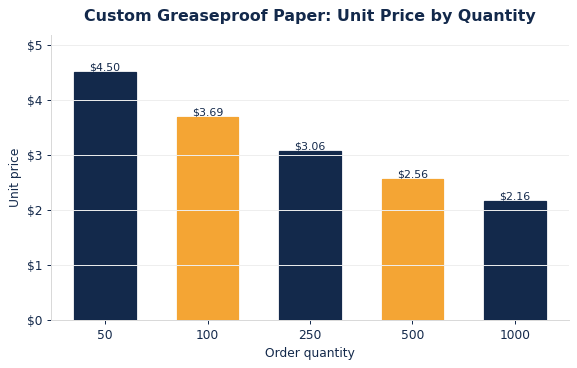
When you order custom greaseproof paper, the spec sheet asks you for a weight — a number in gsm — and it is the one line most buyers guess at. Pick too light and a burger wrap tears in someone’s hands; pick too heavy and you are paying for stiffness a pastry never needed, and fighting paper that won’t drape. Weight, or grammage, is the quiet variable that decides how your printed sheet feels, folds, and holds up in service. Here is what gsm measures, what weight each job actually calls for, and the one thing gsm does not tell you.
What gsm actually measures
GSM stands for grams per square metre: the weight of a single square metre of the paper. It is a density-of-sheet figure, not a thickness or a quality grade. A 40 gsm sheet weighs 40 grams per square metre; an 80 gsm sheet weighs twice that for the same area. Because it is measured per unit area, gsm lets you compare a small deli square and a large butcher sheet on equal terms — the number describes the stock, not the cut size. Higher gsm generally means a stiffer, stronger, more substantial sheet; lower gsm means a lighter, more flexible one that drapes and wraps easily. That single trade-off, stiffness versus drape, is most of what the weight decision comes down to.
The weight your job actually needs
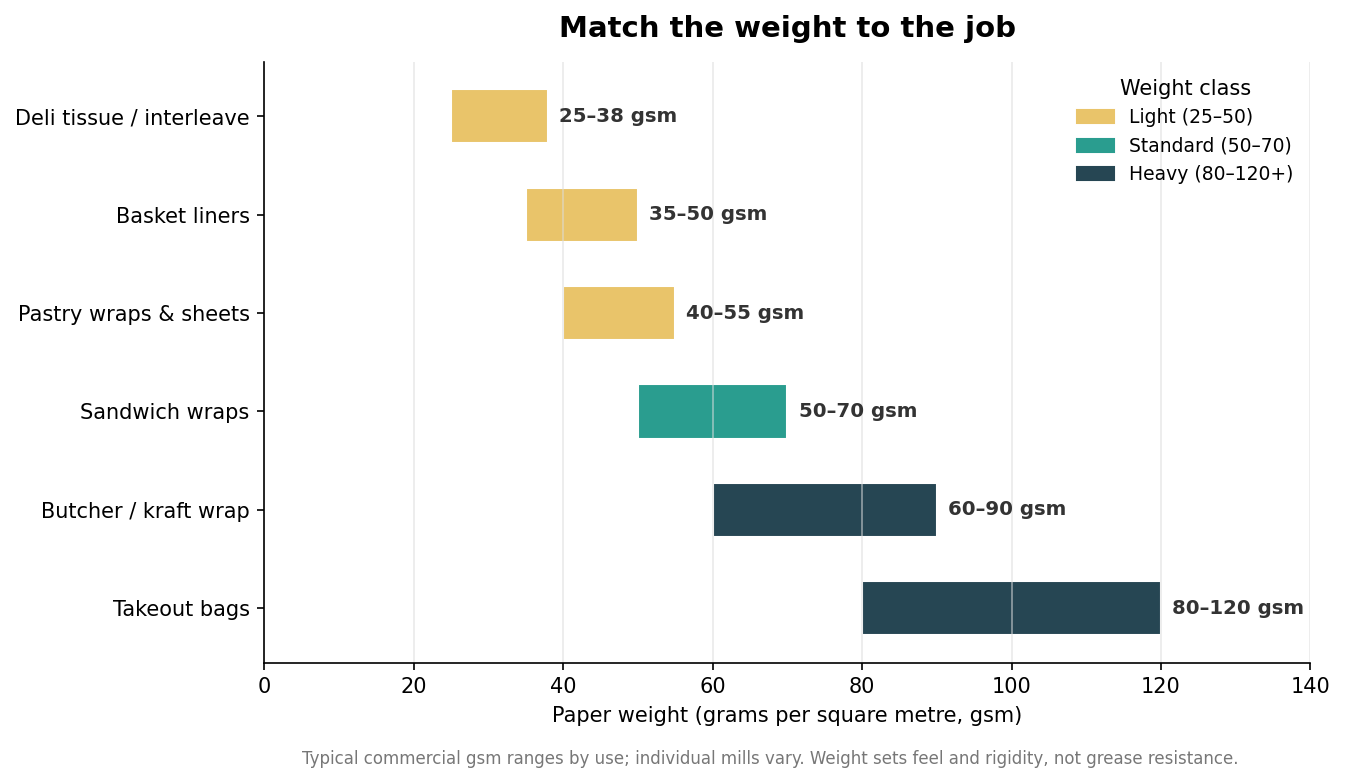
Different jobs sit in different weight bands, and the ranges are well established across the industry. The lightest papers, roughly 25 to 38 gsm, are the tissues and interleaving sheets that separate pastries or line a deli case — they need to be thin and flexible, not strong. Basket liners for fries and bread service run a little heavier, around 35 to 50 gsm, enough to hold shape in a basket without becoming board-like. Pastry wraps and bakery sheets land near 40 to 55 gsm. Sandwich and burrito wraps, which get folded, tucked, and handled, sit in a 50 to 70 gsm standard band. Heavier still are butcher and kraft wraps for burgers and hot messy items at roughly 60 to 90 gsm, and takeout bags, which need real structural strength, at 80 gsm and up.
Typical gsm ranges by application, from light deli tissue to heavy takeout bags.
The pattern is intuitive once you see it laid out: the more a sheet has to physically hold, fold around, or carry, the heavier it goes. A useful shorthand is to think in three bands — light stock under 50 gsm for lining and separating, a standard 50 to 70 gsm for wrapping, and heavy 80 gsm-plus for structural jobs. Land in the right band first, then fine-tune within it based on how the paper feels in your hand.
The mistake: weight is not grease resistance
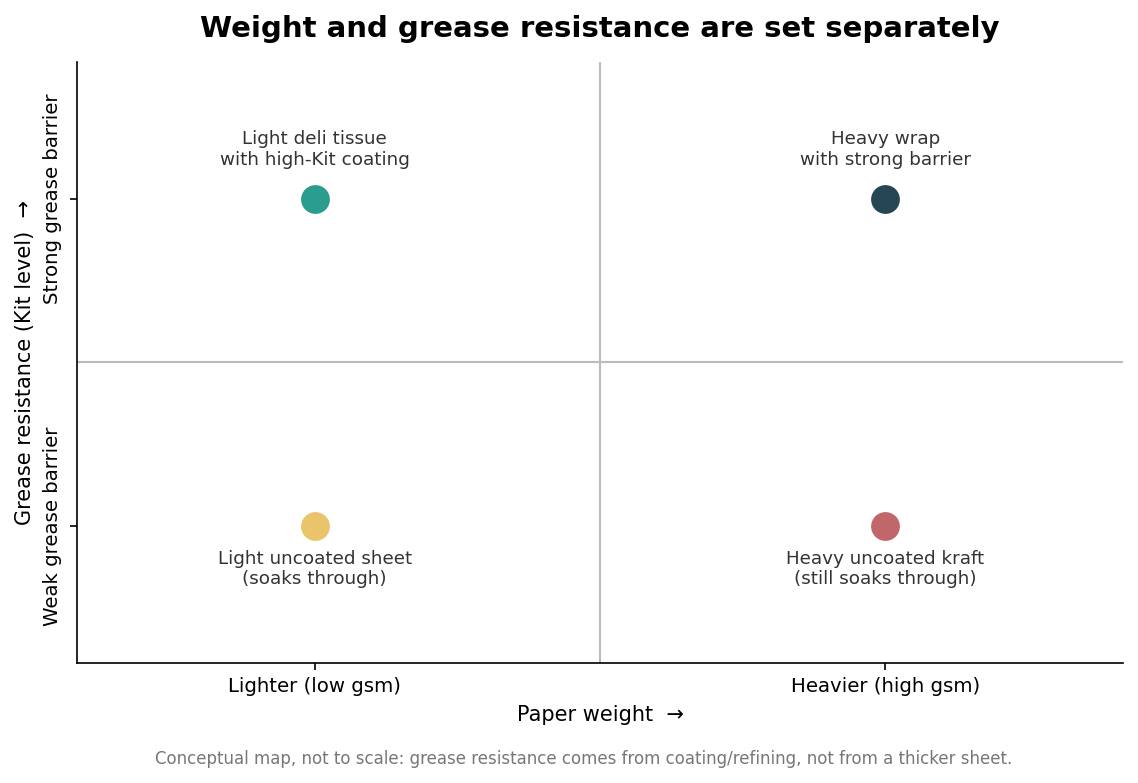
Here is the trap that catches more buyers than any other. It is easy to assume that a heavier, thicker-feeling sheet must resist grease better — and it is simply not true. Grease resistance comes from the barrier: a coating or a densely refined fiber structure that oil cannot penetrate, measured on a separate scale (the Kit level). Weight comes from how much fiber is in the sheet. The two are set independently at the mill. A heavy, substantial-feeling sheet with no barrier treatment will soak through with oil just as fast as flimsy paper, and a light, thin sheet with a good barrier can shrug off a greasy fry for the whole meal.
Weight and grease resistance are separate specs — a heavy sheet can still soak through.
Specify the two things separately. Choose the weight for the physical job — how the sheet needs to feel and fold — and choose the grease barrier for the food — how oily it is and how long it has to sit. If you only tell a supplier “make it heavy so it doesn’t soak through,” you may get a stiff sheet that still fails, because you asked the wrong specification to do the barrier’s job. Knowing that these are two different knobs is the single most useful thing on this page.
What heavier paper buys you, and what it costs
Assuming the barrier is handled, going heavier does buy real things: more rigidity, better tear resistance, and a more premium hand-feel that signals quality when a customer unwraps their order. That is why a sit-down burger joint might choose a substantial kraft wrap while a bakery reaches for a light tissue. But weight is not free. More grams per sheet means more raw material per sheet, so heavier stock generally costs more per piece and adds up across a large run. It also means more weight per case, which raises freight, and fewer sheets in the same storage footprint. And past a point, extra weight actively hurts: a stiff sheet won’t drape cleanly around a soft item or fold into a neat sandwich pocket. The goal is the lightest weight that still does the job confidently, not the heaviest you can justify.
Specifying weight on your order
When you place a custom order, name the gsm explicitly rather than describing the paper as “thick” or “sturdy,” which mean different things to different mills. Tell the supplier the application — deli sheet, basket liner, sandwich wrap, takeout bag — and either the exact gsm or the weight band you want, and pair it with the grease barrier the food requires. If you are unsure, ask for a sample swatch at two adjacent weights and handle them before committing, since the difference between, say, a 50 and a 60 gsm wrap is easy to feel and hard to picture from a number. Getting the weight right on the front end means your printed paper looks the part, behaves the way your staff expect at the counter, and doesn’t cost you a cent more than the job actually needs.
Printing “recyclable” or “compostable” on a deli sheet or basket liner is one of the easiest ways to strengthen a food brand’s green credentials, and one of the easiest ways to make a claim that quietly does not hold up. Whether your custom greaseproof paper can actually be recycled or composted after a customer is done with it is decided almost entirely by two things: the coating on the paper, and how greasy the sheet is when it hits the bin. Get either wrong and the claim on the packaging is, at best, wishful. Here is what is true for each type, and how to specify an order whose environmental label survives a second look.
Why grease is the enemy of recycling
The instinct is that paper equals recyclable, but food packaging breaks that rule. Recycling mills turn paper back into fiber by pulping it in water, and oil does not mix with that process. Food oils, grease, and non-stick coatings cannot be separated from the paper fibers during pulping, and a heavily soiled batch can contaminate the pulp badly enough to ruin an entire run of recycled paper. That is why most municipal recyclers reject visibly greasy paper outright. A clean, unused offcut of genuine greaseproof paper is recyclable like any other paper, but the used sheet that wrapped a burger is not, no matter what the roll it came from was made of.
This is the single most common gap between a printed claim and reality. If your sheets are used for fried food, deli items, or anything oily, “recyclable” describes the paper you shipped, not the paper your customer throws away. For food-contact use, composting is almost always the more honest environmental route than recycling.
Composting is where greaseproof paper can genuinely win
The good news is that the grease which ruins recycling is a non-issue for composting. Commercial composters routinely accept food-soiled paper — pizza boxes, napkins, plates — precisely because their high heat breaks it down and the food residue is just more organic matter. The catch is that only some greaseproof papers are compostable at all, and it comes down to the coating.
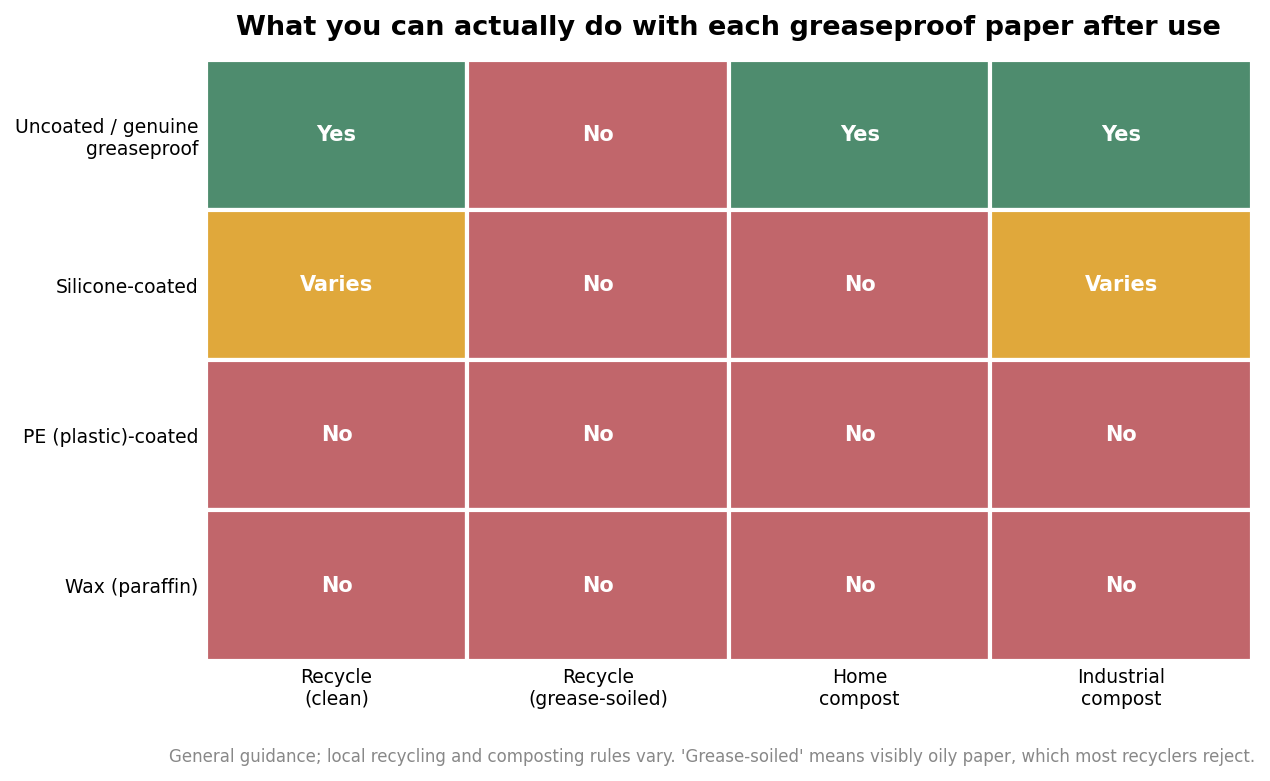
The coating, not the label on the roll, decides whether a used greaseproof sheet can be recycled or composted.
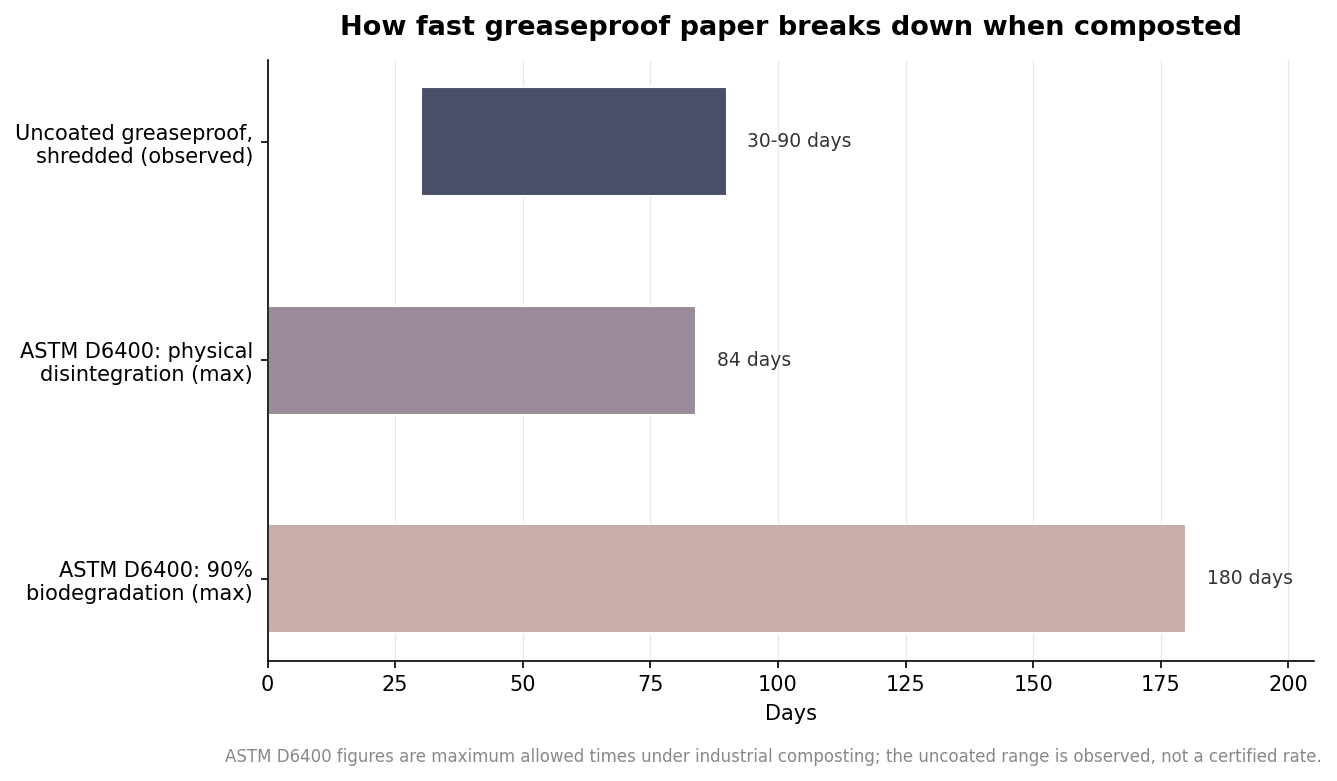
Uncoated or “genuine” greaseproof paper — the kind that resists grease through mechanical refining of the fibers rather than a surface coating — is the strong performer. It is made of natural fibers, and when shredded and mixed into a carbon-rich pile it breaks down in roughly 30 to 90 days under good conditions. That makes it a candidate for both home and industrial composting. Silicone-coated paper is a different story: the silicone is heat-resistant and inorganic, so in a backyard pile the paper vanishes but the silicone remains as micro-residue, which is why it is not considered home compostable and is accepted only by some industrial facilities. PE (plastic)-coated and traditional wax (paraffin) papers fail on both counts — the plastic or petroleum wax neither composts nor survives the recycling pulper — and generally belong in the trash.
What the compostable standards actually require
If you want to print the word “compostable,” it helps to know what a certifier is testing for, because the term is standards-based rather than a general description. In the United States the reference standard for industrial composting is ASTM D6400, and it is stricter than most people assume. To pass, a material must biodegrade at least 90% into carbon dioxide within 180 days, and it must physically disintegrate within about 84 days so that what remains passes through a 2mm sieve with no visible fragments. It must also leave compost that is not toxic to plants and does not carry heavy metals above tight limits.
Uncoated greaseproof composts in about 30-90 days; ASTM D6400 sets outer limits of 84 and 180 days for certified industrial composting.
Two details matter for a buyer. First, ASTM D6400 describes industrial composting, which runs hot — roughly 55 to 70°C — not the cooler, slower conditions of a backyard bin, which may take six to twelve months and often never reach the required heat. A separate certification, TÜV Austria’s OK compost HOME, covers home compostability and is the label to look for if you want to claim customers can compost the sheet at home. Second, the claim needs a certifier: ASTM writes the test, and an organization such as the Biodegradable Products Institute (BPI) verifies that a specific product passes and issues the certification, with re-certification typically every three years. “Compostable” without one of these certifications behind it is a term you should avoid on printed packaging.
Specifying an order whose green claim holds up
The practical path is to decide the claim first, then let it dictate the material. If you want to print compostable, order uncoated genuine greaseproof and ask your supplier which certification it carries — BPI or ASTM D6400 for industrial, OK compost HOME for home — and match your printed wording to that exact scope rather than a vague “eco” label. If your sheets need a moisture or grease barrier stronger than uncoated paper provides, a compostable bio-coating such as PLA can preserve the claim where a PE coating would destroy it, so specify the coating chemistry explicitly rather than accepting “coated” at face value. Confirm that your inks are suitable for food contact and compostable systems, since a heavy metallic or non-approved ink can disqualify an otherwise compostable sheet.
And keep the recycling language honest. Because your paper will usually be used with oily food, avoid a blanket “recyclable” claim and lean on the compostable message, which is both truer and more useful to the customer standing over the bin. The numbers here are indicative and depend on local facilities and conditions, so the safest wording points customers to “where accepted” composting rather than promising an outcome your supply chain cannot guarantee. Choose the coating to match the claim, back the claim with a real certification, and your custom greaseproof paper can carry an environmental message that stands up.
Four papers show up again and again in a food business: greaseproof, parchment, wax, and butcher paper. They can look almost identical stacked on a shelf, and they get swapped for one another constantly, usually by someone who then wonders why the sheet stuck to the pan or melted onto a brownie. They are not interchangeable. Each is built for a different combination of heat, grease, and moisture, and picking the wrong one is the difference between a clean release and a ruined tray. Here is what actually separates them and how to choose without second-guessing.
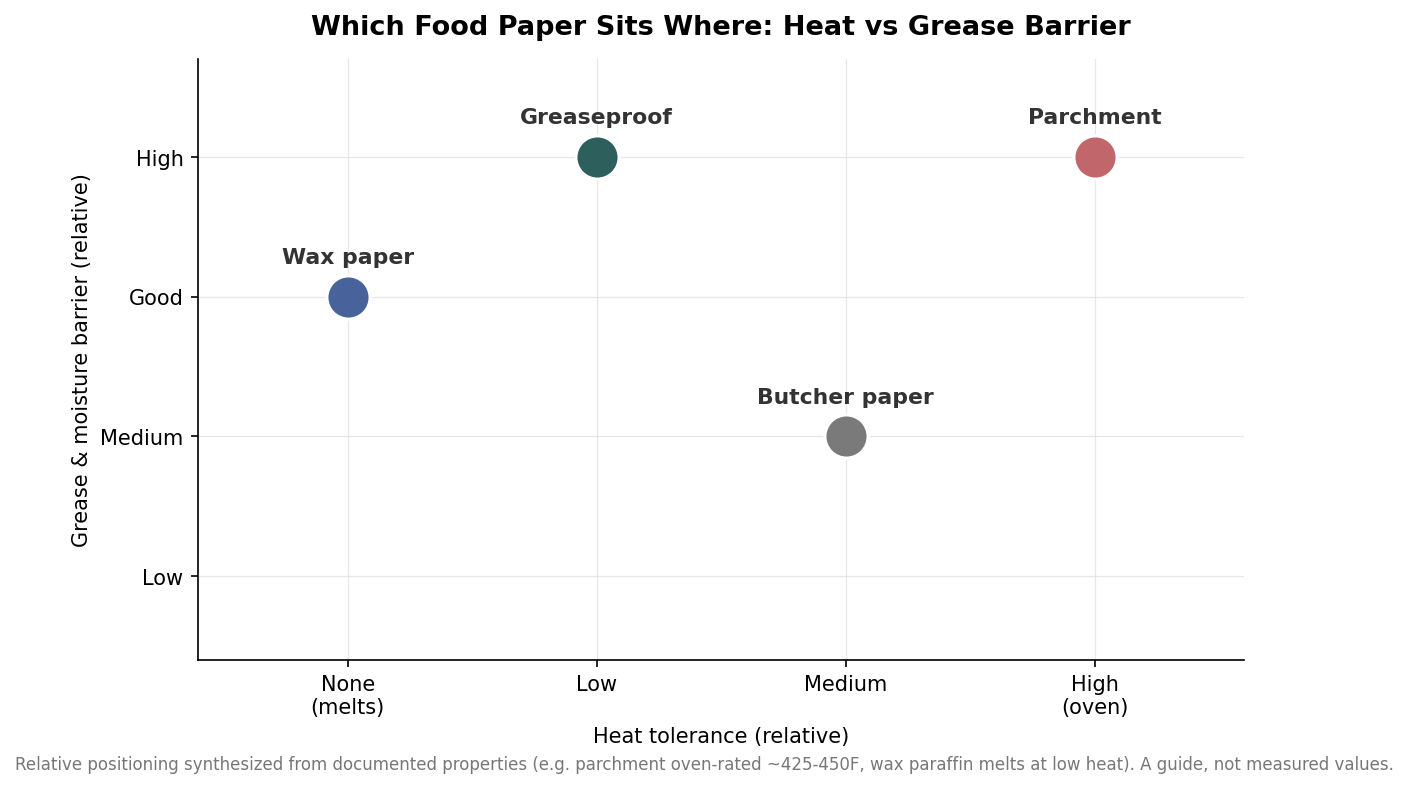
Where each food paper sits on heat tolerance versus grease and moisture barrier.
Greaseproof paper: the wrap-and-serve specialist
Greaseproof paper earns its name through how it is made, not through a coating. The pulp is heavily refined and calendered so the fibers pack tightly, forming a natural barrier that oil struggles to pass through. That means no wax, no silicone, and a clean, food-safe surface that takes printing well, which is why it is the standard for branded deli sheets, basket liners, sandwich wraps, and takeaway. The trade-off is that the barrier is physical, not chemical: over long contact with very wet or very oily food it will eventually absorb some moisture, and it is not designed for sustained oven heat. Weights are typically light, often in the rough range of 30 to 50 gsm depending on the format, though that figure is indicative and varies by supplier. If your job is to hold, wrap, line, and brand food at serving temperature, this is the paper built for it.
Parchment paper: the one built for the oven
Parchment is the paper you bake on, and the reason is a food-safe silicone coating bonded to treated cellulose fibers. That coating does two things greaseproof cannot: it releases stuck food cleanly and it tolerates real oven heat, commonly rated to around 425 to 450°F (about 232°C). Cookies lift off without tearing, roasting vegetables do not weld to the tray, and cleanup is trivial. What parchment is not is a branding surface. The silicone that makes it non-stick also makes it a poor candidate for the kind of printed, under-the-food presentation greaseproof handles so well, and using it purely to wrap a cold sandwich is overkill you are paying for. Reach for parchment when the paper is going into the oven; skip it when it is not.
Wax paper: cold jobs only
Wax paper looks like a cheaper parchment and behaves nothing like it. Its slick surface comes from a paraffin wax coating, and paraffin softens and melts at low temperatures, well below baking heat. Put wax paper in a hot oven and the coating melts and can smoke, which is exactly why it belongs to cold and room-temperature tasks: separating burger patties or cookie-dough layers, wrapping a sandwich for a few hours, lining a container, rolling out candy. There is one narrow exception worth knowing: wax paper can line a cake or brownie pan if the batter completely covers it, because the food shields the wax from direct heat. Outside that specific case, treat wax paper as a storage-and-wrapping material and keep it away from the oven entirely.
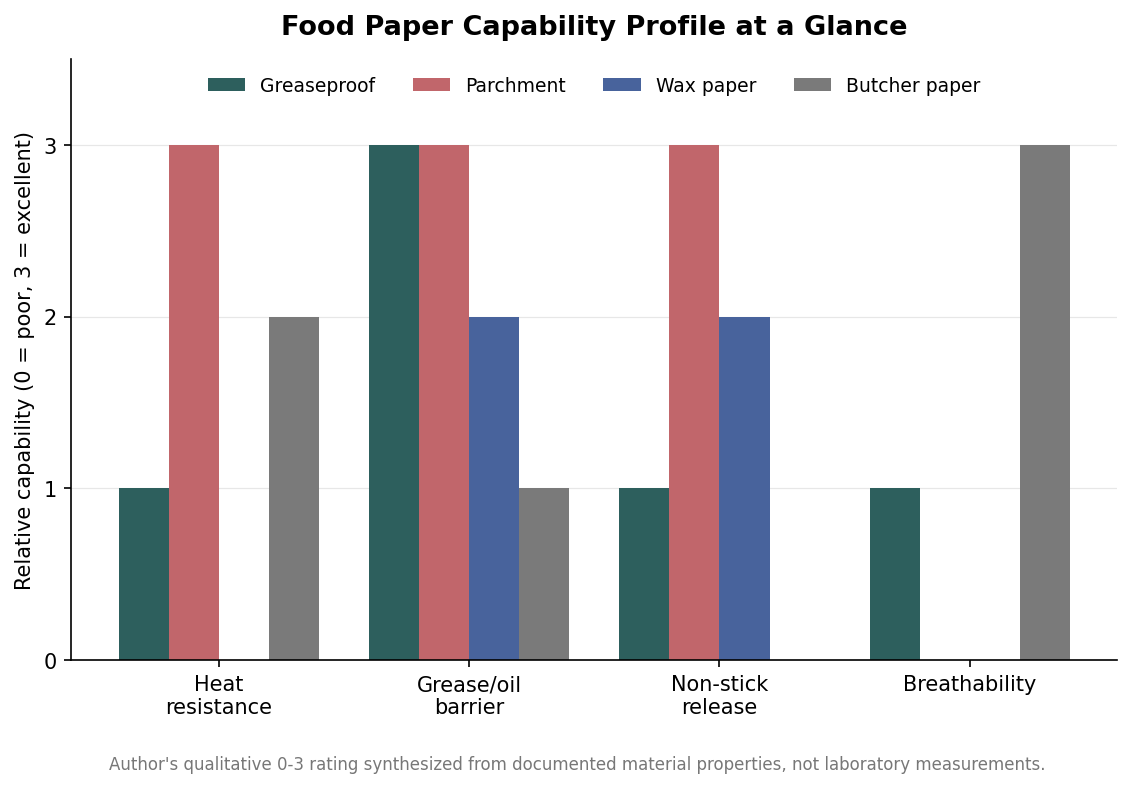
A capability profile comparing the four papers across the properties that matter in a kitchen.
Butcher paper: breathable, not grease-proof
Butcher paper is the odd one out, because it is not really trying to be a grease barrier at all. It is an uncoated, unwaxed kraft paper, and the pink or peach version that barbecue cooks favor is prized precisely because it is breathable. Wrap a brisket in it at smoker temperatures, commonly in the 250 to 275°F range, and steam escapes rather than pooling, so the bark stays firm while the meat keeps some moisture, something neither foil nor a coated paper can do. It is also the classic table covering and a sturdy wrap for cuts at the counter. What it will not do is stop grease the way greaseproof does; kraft fibers absorb oil, so a burger sitting on plain butcher paper will leave a spreading stain. Rolls are heavier stock, often around 60 gsm and sold in long widths like 18 inches by 175 feet. Choose it for smoking, resting meat, and covering surfaces, not for holding greasy food on a plate.
How to choose without overthinking it
Strip away the marketing and the decision comes down to a single question: what is the paper being asked to survive? If it goes in the oven, you want parchment for its silicone coating and heat rating. If the job is cold storage or separating layers, wax paper is the cheap, correct answer. If you are smoking or resting meat, or covering a table, butcher paper’s breathability is the whole point. And if you are wrapping, lining, or serving food at temperature, and especially if you want your logo under it, greaseproof is the printable workhorse that does that job better than any of the other three. The capability profile above lays the four side by side so the pattern is obvious: no paper wins every category, and the “best” one is simply whichever matches the task in front of you.
The common mistakes all come from ignoring that question. People bake on wax paper and get smoke, they wrap greasy food in butcher paper and get stains, and they pay for parchment to wrap a cold sandwich a plain greaseproof sheet would have handled for a fraction of the cost. Match the paper to the heat and the grease it will actually see, and each one quietly does exactly what it was designed to do.
If you’ve started pricing out custom greaseproof paper for your restaurant, bakery, or food truck, you’ve probably noticed the numbers all over the place — one supplier quotes 500 sheets, another won’t talk to you below 30,000. That spread isn’t a pricing gimmick; it comes down to printing method, and it changes what you should actually ask for on your first call.
Custom greaseproof paper is the sheet or roll stock printed with your logo, colors, or pattern and coated or treated to resist oil, butter, and sauce soak-through — the wrap under your burger, the liner in your fry basket, the sheet lining a bakery box. Before you send a design file anywhere, it helps to know what quantities, weights, and lead times are actually normal in this category, and which compliance issue (PFAS) is now showing up in state law and worth asking your supplier about directly.
Below is what the research turned up on pricing, minimum orders, paper weight, and the PFAS rules now in effect in several states — figures worth having in hand before you request quotes.
How much does custom greaseproof paper cost?
Per-sheet pricing on custom greaseproof paper drops fast once you clear the first volume break. Wholesale pricing can fall to around $0.15 per sheet at bulk quantities, and most suppliers structure their tiers so that stepping up from a 500-sheet order to 1,000 sheets lowers your cost per unit even though the total invoice goes up. That’s the main lever available to a single-location operator: order the next tier up if you have the storage space, because the price curve rewards it.
What actually moves the number more than volume alone is the printing method. A digital short-run press can put your logo on a few hundred sheets economically because there’s no plate to make. A flexographic press — the standard for large-format roll printing — needs a custom plate for your artwork, which is a fixed cost spread across the run. That’s why flexo-based suppliers push their minimums into the tens of thousands: below that, the plate cost dominates the price per sheet and the math stops working for either side.
What drives the per-sheet price beyond volume
Number of ink colors, sheet size, coating type, and whether you’re ordering pre-cut sheets versus a roll all factor into the quote. Single-color logos on a standard 12×12 or 15×15 inch sheet sit at the cheap end; full-color wraps with a custom die-cut size cost more per unit and often come with a separate plate or setup fee on top of the paper itself.
Minimum order quantities: what’s actually normal
MOQs on custom greaseproof paper span a wide range because the category includes both small digital printers serving single restaurants and large converters serving regional chains. On the low end, small-run specialty printers will take orders starting around 500 to 1,000 sheets. On the high end, converters running custom sizes on flexo equipment set minimums at 30,000 to 50,000 units, because that’s the run length needed to justify the plate and changeover cost.
If you’re a single location testing a design or gauging staff reaction to a new wrap, look specifically for a supplier advertising a sub-1,000-sheet minimum — that phrase, or ‘no minimum,’ is doing real work in a search result and worth filtering for. If you’re outfitting multiple locations or plan to reorder the same design for a year or more, the 30,000+ tier suppliers will get you a meaningfully lower unit cost and it’s worth the larger upfront commitment.
Minimum order quantities for custom greaseproof paper range from roughly 1,000 sheets at small-run printers to 50,000 units at large-format converters.Source: MOQ listings published by thedelipaper.com, fastfoodpak.com, and noissue.co, accessed August 2026
Paper weight and what actually makes it greaseproof
Greaseproof paper is commonly available in 30, 35, and 40 gsm weights, with heavier stock going up from there for applications that need more structural rigidity, like bag bottoms or box liners. Weight alone, though, isn’t what stops oil from soaking through — grease resistance comes from the paper’s barrier chemistry, not its thickness. A correctly beaten, dense pulp or a surface-applied oil-repellent coating can make a lighter 30–35 gsm sheet outperform a heavier, untreated one that goes translucent the moment it touches a hot, oily burger patty.
This matters when you’re comparing quotes: two suppliers offering the same gsm number aren’t necessarily offering the same performance. Ask what makes the sheet grease-resistant — dense pulp processing, a wet-strength additive, or a coating — rather than assuming a higher gsm number is doing the work by itself.
Regulatory compliance for food-contact greaseproof paper in the U.S. falls under 21 CFR 176.170 and 176.180. Ask any new supplier for documentation against those sections before you commit to a full print run, especially if you’re supplying a chain with its own compliance requirements.
PFAS-free stock is no longer optional in some states
Grease resistance historically came from PFAS-based coatings — durable, effective, and now banned or being phased out in a growing list of states. If you operate in, ship into, or supply a chain with locations in any of the states below, ask your supplier directly whether their greaseproof paper is PFAS-free; several have already made the switch standard, but not all have, and the older PFAS-coated stock is still in some supply chains.
New York was first, restricting intentionally added PFAS in plant-fiber food packaging back in 2022, and the list has grown steadily since. If your business operates in more than one state, it’s simpler to standardize on PFAS-free custom greaseproof paper across every location now rather than track which states currently allow the older coating.
Nine states have enacted or scheduled bans on intentionally added PFAS in food packaging, with the list growing through 2028.
State
PFAS Food-Packaging Ban Effective
New York
2022
Connecticut
2023
Colorado
2024
Minnesota
2024
Hawaii
2024
Oregon
2025
Rhode Island
2025
New Mexico
2027 (phase-in)
California
2028
Nine states have enacted or scheduled bans on intentionally added PFAS in food packaging, with the list growing through 2028.Source: PFAS-Free Take-Out Packaging: A Practical State-by-State Guide, this-element.com, updated September 2025
Lead times: when to order if you have a launch date
Turnaround after you approve final artwork typically runs one to three weeks, and it tracks closely with the same printing-method split that drives MOQ and price. Digital and small-batch printers quoted turnaround in the 1–2 week range in supplier listings checked for this guide, since there’s no plate-making step. Larger converters running custom sizes on flexo presses quoted 8 to 12 working days once art is approved, with some greaseproof-specific runs stretching to 2–3 weeks depending on order size and current press schedules.
Build in extra time on the front end for proofing. Most of the delay in a first order isn’t press time — it’s back-and-forth on a digital proof or, for larger flexo runs, a physical plate proof before the full batch runs. If you’re working toward a hard launch date, get your artwork finalized and proofed at least a week before you actually need press time to start, and confirm your supplier’s stated lead time starts counting after approval, not after you submit the file.
Frequently asked questions
What’s the minimum order for custom greaseproof paper?
It depends on the printing method. Small-run and digital printers will often start around 500–1,000 sheets, while larger converters using flexographic printing for custom sizes typically require 30,000–50,000 units because of plate setup costs. If you only need a small test batch, search specifically for suppliers advertising low or no minimums rather than assuming the industry standard.
How much does custom printed greaseproof paper cost per sheet?
Pricing varies with quantity, sheet size, and number of print colors, but bulk wholesale pricing can fall to around $0.15 per sheet at high volumes. Ordering the next quantity tier up — say 1,000 sheets instead of 500 — generally lowers your cost per sheet even though your total order cost increases.
What gsm weight should I choose for greaseproof paper?
30–40 gsm covers most sandwich wraps, deli sheets, and box liners. Go heavier if the sheet needs to hold structural weight, like a bag bottom. Weight isn’t the only factor in grease resistance, though — ask your supplier what barrier treatment or coating the paper uses, since that determines whether it stays dry against hot, oily food rather than the gsm number alone.
Is custom greaseproof paper required to be PFAS-free?
It depends on where you operate. States including New York, Connecticut, Colorado, Minnesota, Hawaii, Oregon, and Rhode Island have already banned intentionally added PFAS in food packaging, with New Mexico and California phasing in bans by 2027 and 2028. If you operate in any of these states, or ship product into them, confirm your paper is PFAS-free before ordering.
How long does a custom greaseproof paper order take?
Typical lead times run one to three weeks after you approve final artwork. Digital short-run printers tend to be faster, often 1–2 weeks, while larger converters running custom flexo plates report 8–12 working days to about three weeks depending on order size. Add extra time upfront for proofing before the lead-time clock even starts.
Can I order a small test batch before committing to a full print run?
Yes — look for suppliers with sub-1,000-sheet minimums or digital printing options rather than flexo converters. A small test run costs more per sheet but lets you check ink color accuracy, grease performance under your actual menu items, and staff feedback before you commit to a 30,000+ unit order.
The bottom line
The custom greaseproof paper category splits cleanly into two buying paths: a small, flexible order from a digital printer if you’re testing a design or running one location, and a large flexo-printed run if you’re standardizing across multiple sites and want the lowest per-sheet cost. Match your quote requests to which path you’re actually on, confirm PFAS-free stock if you operate in a regulated state, and ask what’s making the paper grease-resistant rather than just checking the gsm number — those three questions will save you a reorder.
Two shops can order the exact same custom greaseproof sheet — same 40 gsm stock, same 12″ × 12″ cut, same one-color logo — and pay wildly different prices, simply because one ran it digitally and the other ran it flexo. The print method is the single biggest lever on what a run costs and how fast it ships, and it is the one decision most buyers never actually make on purpose. This guide walks through the three methods you will be quoted on — digital, flexographic, and offset — and shows where each one wins so you can match the method to the job instead of taking whatever the supplier defaults to.
The three methods, and what actually separates them
Digital printing puts your artwork straight onto the paper with no physical plates, the same way a large-format office press would. Because there is nothing to tool up, setup cost is effectively zero and you can economically print a few hundred sheets. It handles full-color artwork, photographs, and gradients without extra charges, and it lets you change the design between runs at no penalty. The trade-off is the per-sheet rate: digital stays relatively flat as quantity climbs, so it never gets dramatically cheaper at scale.
Flexographic printing — flexo — transfers ink from a raised, flexible plate, one plate per color. It is the workhorse of food-paper printing because once the plates are made, the press runs fast and the ink cost per sheet is tiny. Flexo uses fast-drying, water-based food-safe inks formulated so the sheet does not go soggy, which is exactly what you want on a grease-facing surface. The catch is the plates: you pay to make them before a single good sheet comes off the press, and each additional color is another plate.
Offset printing transfers ink from a metal plate to a rubber blanket and then onto the paper. It produces the sharpest fine detail and the most consistent color of the three, which matters for intricate logos or tight brand-color matching. Like flexo it carries real plate and makeready costs, so it only makes financial sense on large runs where that setup is spread across a lot of sheets.
Where the money actually goes
The cost of a printed run has two parts that behave very differently: a fixed setup cost you pay once, and a per-sheet cost you pay on every unit. Digital shifts almost everything into the per-sheet number and charges nothing up front. Flexo and offset load cost into setup and then run cheaply. That single structural difference is why quantity decides the winner.
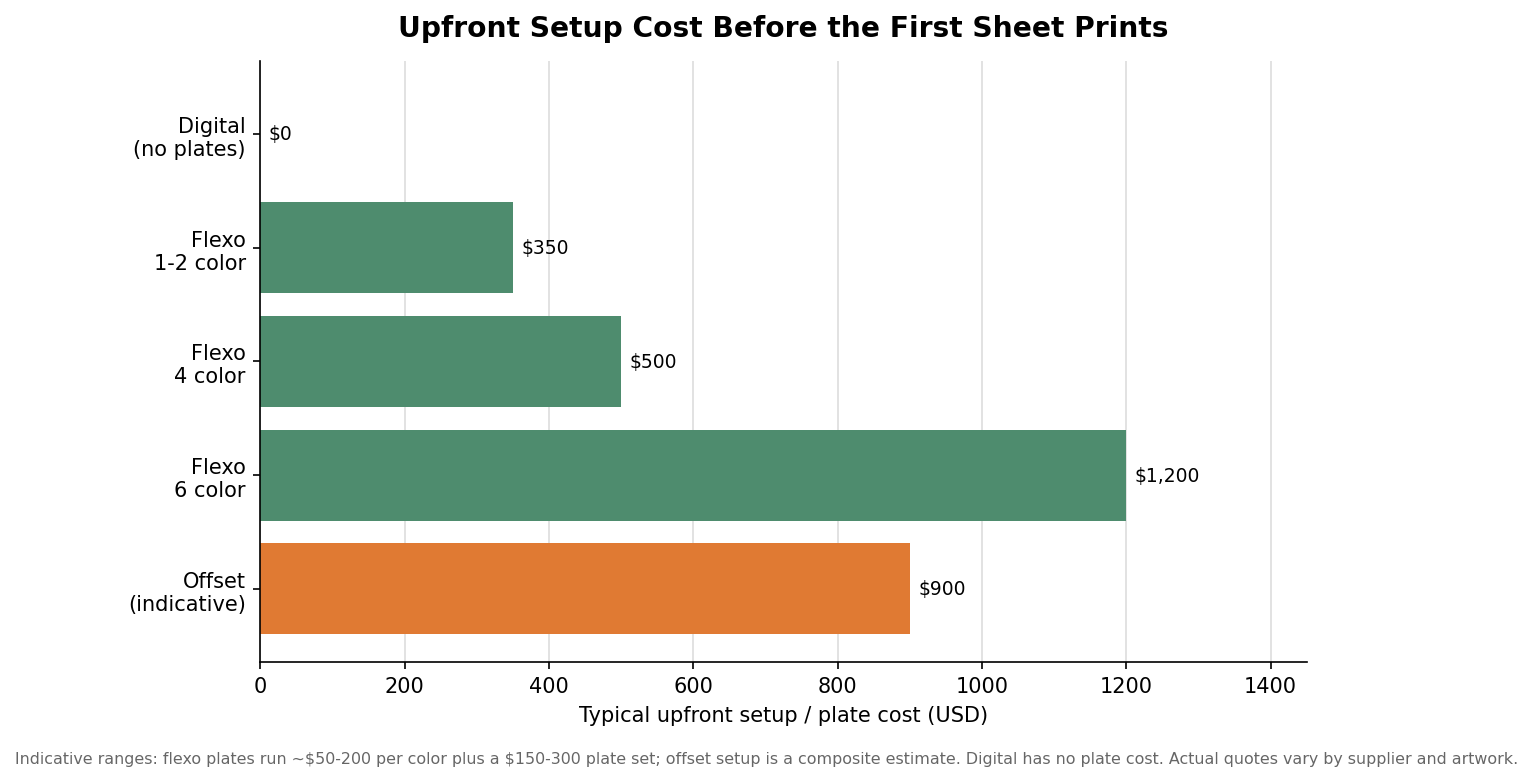
Setup is the part buyers underestimate. On flexo, plates commonly run in the range of roughly $50 to $200 per color, plus a plate-set or imaging fee often in the $150 to $300 band, so a simple one- or two-color job carries a few hundred dollars of tooling before you count paper. A four-color flexo job frequently lands somewhere around the mid-hundreds, and a six-color set can push past $1,000. Digital skips all of it. Offset setup is higher still and varies enough by press and format that any single figure is only a placeholder. The chart below shows the rough shape of that upfront cost by method — treat the numbers as indicative ranges, not quotes.
Upfront setup cost by method: digital pays nothing to start, while flexo and offset tool up first.
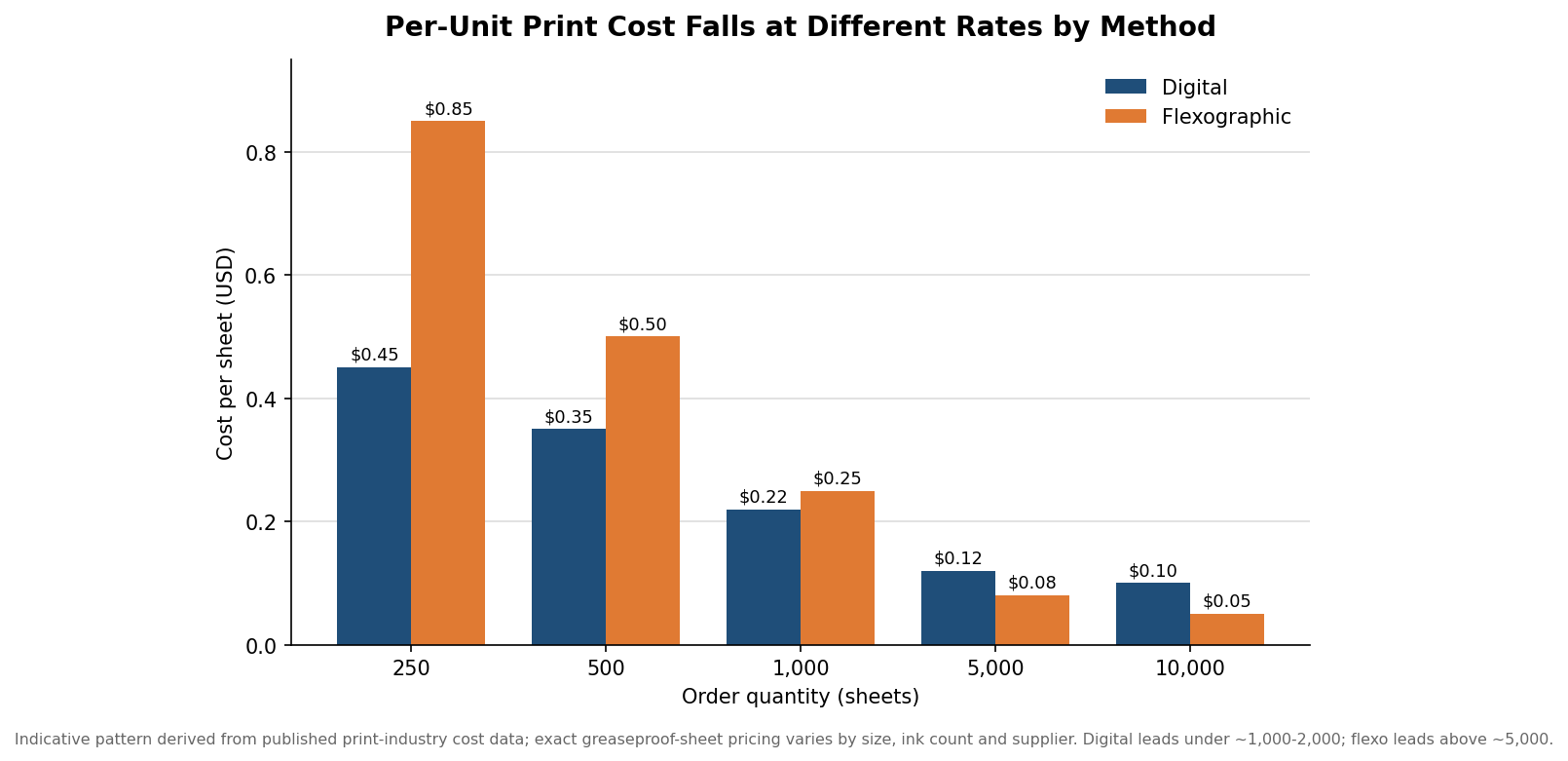
Now layer the per-sheet cost on top. Because flexo runs so cheaply once it is set up, its total cost per sheet keeps falling as the run grows, while digital flattens out. Below a few hundred to a couple thousand sheets, digital is usually cheaper overall because you are not paying for plates. Somewhere in the low thousands the two lines cross, and past roughly 5,000 sheets flexo pulls clearly ahead. The comparison below traces that crossover using published print-cost patterns; the exact dollar figures shift with sheet size and ink count, but the shape holds for greaseproof work.
Digital is cheaper per sheet at low volumes; flexo overtakes it past a few thousand sheets.
Minimum order quantities set the floor
Method also dictates how small you are allowed to go. Digital’s plate-free setup means suppliers will often take orders starting around 250 sheets, which is what makes it viable for a new food truck testing a design or a caterer printing for a single event. Flexo minimums typically start higher — commonly around 500 sheets and often more — because a supplier will not tool up plates for a tiny run. Offset minimums are higher again. If you only need a few hundred branded sheets, the decision is effectively made for you: digital is the method that will accept the order at all. If your annual volume is in the tens of thousands, the minimums never bind and you should be choosing on per-sheet cost instead.
Color, detail, and lead time
Match the method to the artwork. A clean one- or two-color logo prints beautifully and cheaply on flexo, and that describes most deli-sheet and basket-liner branding. If your design is full-color, uses photographic imagery, or blends gradients, digital handles it without per-color charges and is usually the practical choice at small to mid volumes. When you need the crispest possible fine lines or an exacting brand-color match across a very large run, offset earns its setup cost.
Speed follows the same logic. Digital’s lack of tooling makes it the fastest to start, with production often quoted in the 3 to 5 business day range, while flexo more typically runs 7 to 10 days once plates are factored in. For custom greaseproof specifically, a common end-to-end window for printing and delivery is around 6 to 8 business days, though anything with new plates, multiple colors, or a large quantity can run longer. If a fixed event date is driving the order, confirm the lead time in writing before you commit, and remember that reordering the same flexo design later is faster and cheaper because the plates already exist.
A simple way to decide
Start with quantity, because it settles most cases on its own. Under about 1,000 sheets, or any time you want to test or frequently change a design, digital almost always wins on both cost and flexibility. Above roughly 5,000 sheets of a stable, simple design, flexo’s cheap per-sheet rate makes it the clear economic pick, and its food-safe, fast-drying inks are purpose-built for grease-facing stock. In the middle — very roughly 1,000 to 5,000 sheets — the two methods are close enough that color count, reorder plans, and lead time should break the tie: heavy color or a one-time run leans digital, while a simple design you expect to reorder leans flexo since you amortize the plates across future orders. Reserve offset for large runs where fine detail or exact color consistency genuinely justify the higher setup.
Whatever the method, hold two things constant: confirm the inks are water-based and food-safe for direct contact, and ask the supplier to state setup cost, per-sheet cost, minimum order, and lead time as separate line items. Once those four numbers are on the table, the right print method for your run tends to pick itself.
Greaseproof paper sits directly against food, which makes it a food-contact material and, since 2023, a regulated one in much of the country. Two separate questions decide whether a given sheet is fit for the job, and buyers often collapse them into one. The first is performance: does the paper actually stop grease from soaking through under your hottest, oiliest menu item. The second is compliance: is the paper free of the fluorochemicals that a growing list of states now ban in food packaging, and can the supplier show it meets food-contact rules. A sheet can pass one test and fail the other, so it pays to understand both before committing to a print run.
How grease resistance is actually measured
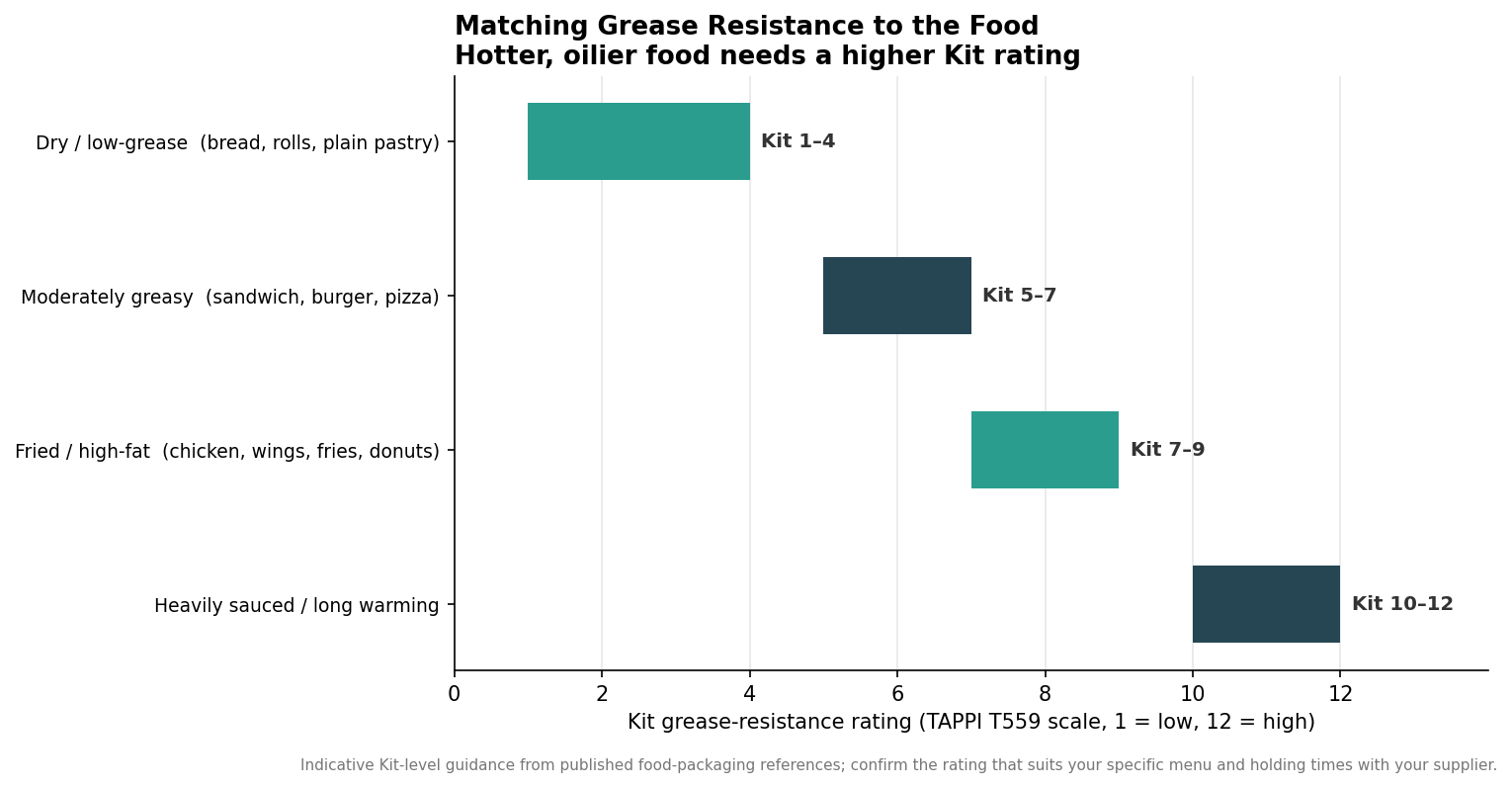
The industry does not grade greaseproof paper by feel, it grades it with the Kit test, standardized as TAPPI T559. The test applies a series of increasingly aggressive oil-and-solvent mixtures to the paper surface, and the paper’s rating is the highest-numbered solution that can sit on it for fifteen seconds without staining through. The scale runs from Kit 1, minimal resistance, to Kit 12, maximum resistance, so a higher number means a tougher grease barrier. The number you need is driven entirely by what the paper will hold. Dry and low-grease items such as bread, rolls, and plain pastries are served fine by roughly Kit 1 to 4. Moderately greasy foods, the sandwiches, burgers, and pizza slices that make up most counter service, generally call for Kit 5 to 7. Fried and high-fat foods such as chicken, wings, fries, and doughnuts push into Kit 7 to 9, with the upper end recommended when food sits in a warming drawer for half an hour. Heavily sauced items or long holding times are where Kit 10 to 12 earns its keep.
Recommended Kit grease-resistance rating by food type; hotter and oilier foods need a higher rating.
The practical error is to over-spec or under-spec. Buying Kit 12 paper for dry cookies wastes money on a barrier the food will never test, while wrapping fried chicken in a Kit 4 sheet produces exactly the grease-through that stains a customer’s hands and a branded bag. Match the rating to the greasiest thing the paper will actually touch, and account for how long the food sits before it is eaten.
The PFAS shift buyers cannot ignore
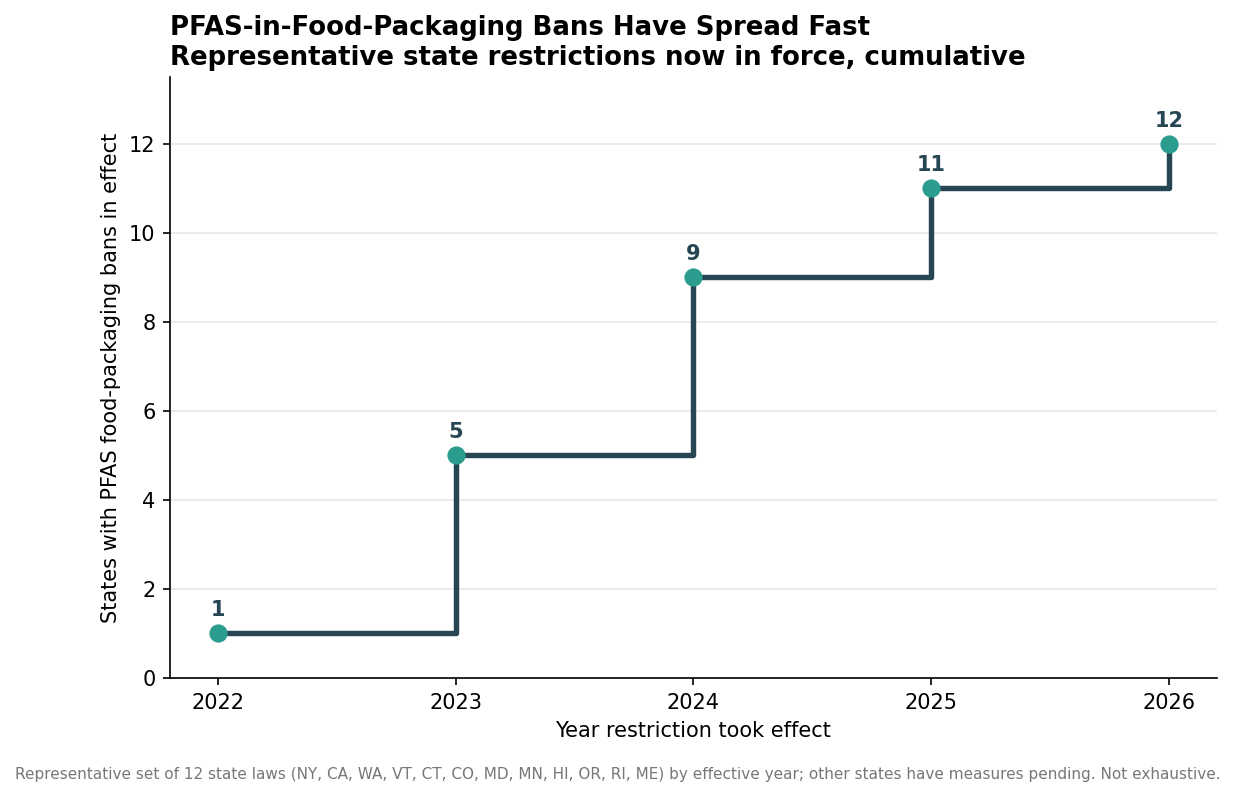
For decades, the cheapest way to hit a high Kit rating at low paper weight was to treat the sheet with per- and polyfluoroalkyl substances, the fluorochemicals known as PFAS. They are extremely effective grease barriers, and they are also persistent in the environment and the body, which is why regulators moved against them in food packaging specifically. The change has been rapid. A representative group of a dozen states, including New York, California, and Washington from 2022 and 2023, then Colorado, Maryland, Minnesota, and others through 2024 and 2025, now bans intentionally added PFAS in food packaging, and more have measures pending. At the federal level, manufacturers completed a voluntary phase-out of PFAS-based grease-proofing agents for paper and paperboard food packaging by early 2024, so those treatments are no longer being supplied into the U.S. market.
A representative dozen state bans on PFAS in food packaging, cumulative by the year each took effect.
For a brand ordering custom greaseproof paper, the upshot is simple: PFAS-treated grease resistance is on its way out regardless of where you operate, and in many states it is already unlawful. Specifying PFAS-free is no longer a premium green choice, it is the baseline a compliant order has to meet.
How PFAS-free paper still stops grease
Removing PFAS does not mean giving up grease resistance, it means achieving it a different way. The most common route is mechanical: heavily refining and densifying the pulp so the sheet’s fibers pack tightly enough that oil cannot travel through, which is the principle behind traditional glassine and genuine greaseproof papers. The second route is a non-fluorinated barrier coating, such as water-based dispersion coatings, clay, silicone, or a thin poly layer, applied to the food-contact side. Each approach has trade-offs worth knowing. Densified papers keep the sheet fully paper-based and often recyclable or compostable, but very high Kit levels can require heavier stock. Coated papers can reach strong grease and moisture resistance at lighter weights, but a plastic or poly coating can complicate composting and recycling. When you ask a supplier for PFAS-free paper at a given Kit level, ask which method delivers it, because that determines both the feel of the sheet and its end-of-life options.
Food-contact and print compliance
Grease resistance and PFAS status are the headline issues, but a compliant sheet has to clear a few more. The base paper and any coating that touches food fall under the FDA’s food-contact rules for paper components, codified at 21 CFR 176.170, so a reputable supplier should be able to confirm the paper is manufactured to food-contact standards. Printing matters too: custom greaseproof paper should be produced with food-safe, low-migration inks, and good practice keeps heavy ink coverage on the side that does not contact the food wherever the design allows. If you intend to make a compostable claim, that is its own certification rather than a byproduct of being paper, and it typically means meeting a standard such as ASTM D6400 or D6868 and carrying third-party certification; a poly-coated sheet generally will not qualify. None of this requires you to become a materials expert, but it does mean the right questions to ask a supplier are specific: confirm PFAS-free status, state the Kit level your menu needs, request food-contact documentation, and clarify the ink and any compostability claims in writing.
Specifying a compliant order
Put together, a sound spec reads less like a wish and more like a checklist. Start from your greasiest, hottest item and pick the Kit level that survives it through your longest holding time. Require PFAS-free grease resistance as a non-negotiable, and ask whether it is achieved by densified fiber or a named coating so you understand the recycling and composting implications. Confirm the paper meets food-contact requirements and that your artwork will print in food-safe inks. Handling those four points before the press runs is what separates paper that merely looks the part from paper that holds the food, protects the brand, and keeps you on the right side of a fast-moving set of rules.
How to Choose Custom Greaseproof Paper for Your Brand: Use Cases and Ordering
The best way to choose custom greaseproof paper is to start from how they will be used, then work back to the material, size, and decoration that fit. Custom greaseproof paper serve very different jobs across food service, e-commerce inserts, retail & branding, and events, and matching the order to the job is what makes custom greaseproof paper feel purpose-built rather than generic. This guide maps the common use cases and walks through ordering custom greaseproof paper that fit your brand.
Whether the greaseproof paper protects a product, presents a gift, or carries a logo into the world, defining that job first keeps every later decision easy. Purpose drives the spec, and the spec drives the result.
How brands use custom greaseproof paper
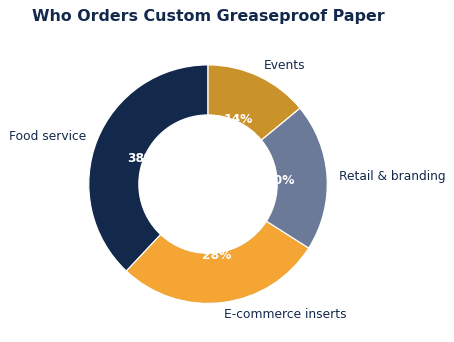
Custom greaseproof paper get ordered for a mix of protection, presentation, and promotion, and knowing where yours fall points you to the right build. The breakdown below shows the common uses, from food service to events.
The common ways brands put custom greaseproof paper to work.
Most orders lean toward one primary job with a secondary benefit — a shipping-focused greaseproof paper that also brands the unboxing, or a gift-focused one that also protects. Naming your primary use keeps the order focused and the spec appropriate.
Use case
What it needs
Food service
branded, food-safe paper that dresses up a serve
E-commerce inserts
thank-you and instruction cards that build loyalty
Retail & branding
labels and wraps that reinforce the brand
Events
printed pieces that tie a theme together
Matching material and size to the use
Once the use is clear, the material and size follow. A protection-first job favors a durable, well-fitted build; a presentation-first job favors a premium material and a clean print; a promotion-first job favors a cost-effective option you can order in volume. Sizing to the product with a small margin keeps the greaseproof paper looking intentional and performing its job.
If a single order serves more than one use, spec to the most demanding one so the greaseproof paper performs everywhere. It is easier to use a slightly sturdier or more premium greaseproof paper across the board than to discover a bargain option falls short for your most important use case.
Branding for the impression you want
Decoration should reinforce the impression the use calls for. Digital and offset printing reproduce full-color art crisply, with spot colors and foil available for a premium touch. For a premium or gift use, lean on finishes and restraint; for high-volume promotion, prioritize a bold, legible logo that reads at a glance and reproduces affordably at scale. Keep branding consistent with the rest of your packaging or merch so everything reads as one system.
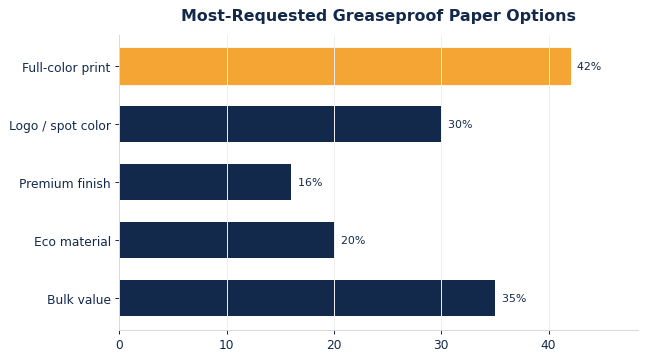
The most-requested options below reflect what buyers reach for most, and they are a useful starting menu when you brief your order. Whatever you choose, approve a proof so the finished custom greaseproof paper match the impression you intended.
The options buyers request most on custom greaseproof paper.
Getting the size and details right
Even with the use and material decided, the details are what make custom greaseproof paper feel finished. Confirm the size and weight against the product with a small margin, check the print area for your chosen size so the logo sits cleanly, and decide on any finishing touches before you brief the order. These small confirmations up front are what separate a greaseproof paper that looks intentional from one that looks close-enough.
A sample or proof is the cheapest insurance you can buy on a greaseproof paper order. A physical sample lets you judge the material and print in hand, while a digital proof confirms artwork, color, and size and weight before the full run. Spending a few minutes here prevents the far larger cost of reworking a finished order of custom greaseproof paper that missed on a detail.
Ordering: quantities, lead time, and reorders
A smooth greaseproof paper order comes down to a few basics: order for real demand plus a small overage, send print-ready artwork early, and confirm lead time against any deadline so production and shipping fit your timeline. Per-unit cost drops with volume, so consolidating a season’s needs into one run is usually more efficient than repeated small orders.
Keep your approved artwork and spec on file so reorders are a quick repeat rather than a fresh setup each time — consistency across runs keeps your brand looking deliberate.
Coordinating with the rest of your brand
Custom greaseproof paper rarely stand alone; they sit alongside your other packaging, print, or merch, so coordinating them strengthens the whole brand. Carrying the same logo, colors, and tone across your greaseproof paper and your other pieces makes everything read as one deliberate system rather than a set of one-off orders. That consistency is what makes a brand feel established, and it costs nothing extra to plan.
Coordination also simplifies buying over time. Standardizing on a material, size, and decoration you are happy with turns future orders into simple repeats, and it keeps every batch matching the last. A little upfront alignment pays back every time you reorder custom greaseproof paper.
Frequently asked questions about custom greaseproof paper
What are custom greaseproof paper used for?
Custom greaseproof paper serve a mix of protection, presentation, and promotion across food service, e-commerce inserts, retail & branding, and events. Most orders lean toward one primary job with a secondary benefit, so naming your main use is the first step in speccing the right greaseproof paper.
How do I match custom greaseproof paper to my use?
Let the use drive the spec: durable and well-fitted for protection, premium and clean for presentation, cost-effective and bold for promotion. If one order serves several uses, spec to the most demanding one so the greaseproof paper performs everywhere.
How should I brand custom greaseproof paper?
Digital and offset printing reproduce full-color art crisply, with spot colors and foil available for a premium touch. Choose finishes and restraint for premium or gift uses, and a bold, legible logo for high-volume promotion, keeping the branding consistent with your other packaging or merch so it all reads as one system.
How far ahead should I order custom greaseproof paper?
Order for real demand plus a small overage, send print-ready artwork early, and confirm lead time against any deadline so production and shipping fit your timeline. Consolidating a season’s needs into one run is usually more efficient than repeated small orders.
Can I reorder easily?
Yes. Keeping your approved artwork and spec on file makes reorders a quick repeat rather than a fresh setup, and it keeps every batch of custom greaseproof paper matching the last for a consistent brand look.
Do I need a sample before ordering custom greaseproof paper?
A sample is worth it for a first order or a new material, since judging feel and print in hand removes the guesswork. For a straightforward reorder of custom greaseproof paper you have bought before, a digital proof confirming artwork and size and weight is usually enough.
Match the greaseproof paper to the job, spec it deliberately, and approve a proof, and your order will do exactly what you needed. For the full material and sizing breakdown, see our companion guide, our Custom Greaseproof Paper: Materials, Sizing & Branding Guide, and browse our our shop to get started.
Not sure which custom greaseproof paper fit your use?
Tell us how you’ll use them and we’ll match the material, size, and branding to the job.
Custom Greaseproof Paper: A Materials, Sizing, and Branding Guide
Getting custom greaseproof paper right comes down to three decisions: the material, the size or spec, and how you brand them. Make those well and you end up with custom greaseproof paper that protect and present your product, reinforce your brand, and land on budget. This guide walks through the material options, how to size and spec your order, and how to decorate custom greaseproof paper so they do real work for your brand rather than just checking a box.
Whether you are ordering your first run or reordering at scale, the same fundamentals apply. Choosing custom greaseproof paper deliberately — material to job, size to product, decoration to brand — is what separates an order you are proud of from one you settle for.
Why custom greaseproof paper matter for your brand
Custom greaseproof paper are more than a commodity; they are a touchpoint brands experience directly. A well-chosen, well-branded option signals quality and attention to detail, while a generic one quietly undercuts an otherwise strong product. Because custom greaseproof paper are seen and handled, they carry your brand into the world every time they are used.
That visibility is exactly why it pays to spec custom greaseproof paper intentionally. The material sets the feel, the size sets the fit and cost, and the decoration sets the impression — and getting all three aligned turns a functional item into a genuine brand asset.
Materials and options compared
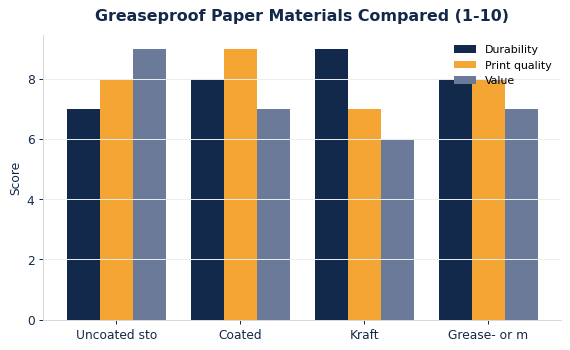
The common materials for custom greaseproof paper each trade off durability, print quality, and cost: uncoated stock, coated / gloss stock, kraft / recycled, and grease- or moisture-resistant. The right pick depends on how the greaseproof paper will be used, the look you want, and your budget. The chart and table below compare the main options so you can match material to job.
How common greaseproof paper materials compare on durability, print quality, and value.
As a rule of thumb, choose a recyclable or natural material when eco positioning matters, a coated or laminated option when you want vivid full-color print, and a premium build when the greaseproof paper is part of a gift or high-end presentation. When in doubt, request a sample so you can judge feel and print before committing to a full run.
Material / option
Best for
Uncoated stock
natural, writable surface with a matte look
Coated / gloss stock
vivid color and a polished finish
Kraft / recycled
eco-forward, warm natural tone
Grease- or moisture-resistant
food-safe performance where needed
Sizing and specs
Sizing is where many greaseproof paper orders go wrong, so measure before you order. Custom greaseproof paper typically range from a small insert card up to a full wrap or liner sheet, and the right size and weight depends on the product or use they serve. Too small and the fit is tight or the product is exposed; too large and you pay for material you do not need and lose a clean, intentional look.
When a measurement falls between standard options, size to the product with a small margin rather than guessing. Confirming the size and weight on a proof or sample before a large run prevents the costly mistake of a full order that does not fit, which is far more expensive to fix than a five-minute check up front.
Branding and decoration
Decoration is what turns a plain greaseproof paper into a branded one. Digital and offset printing reproduce full-color art crisply, with spot colors and foil available for a premium touch. Match the method to your artwork and budget: simple logos reproduce cleanly and cheaply, while detailed, full-color designs shine with the right process on the right material. Keep the artwork vector where possible and confirm the print area for your chosen size.
Restraint usually reads as premium. A clean logo, one or two brand colors, and quality material almost always look more considered than a busy, over-printed design. Approving a proof before the run protects both the look and the budget, especially on a large order of custom greaseproof paper.
Ordering and budget
Per-unit cost on custom greaseproof paper falls steadily with volume as setup amortizes across more pieces, so ordering for real demand rather than a token first batch is usually the efficient move. The curve below shows how pricing typically improves with quantity, which helps you plan an order that balances cash and cost.
Typical per-unit greaseproof paper pricing as order quantity increases.
Ordering for a recurring need? A single larger run lowers the unit cost and keeps your branding consistent, while a small overage covers reorders and the occasional damaged piece without a rush order.
Common mistakes to avoid
A few avoidable missteps account for most disappointing greaseproof paper orders. Ordering before measuring is the biggest, followed by choosing a material for price alone without considering how the greaseproof paper will actually be used, and skipping the proof on a large run. Each is easy to prevent with a few minutes of planning, and each is expensive to fix once a full order is produced.
The other common trap is over-designing the artwork. Cramming in too many colors, effects, or details can muddy the print and raise the cost, especially on textured or recycled materials. Simplifying the design to a clean, legible mark almost always improves both the look and the price of your custom greaseproof paper.
Frequently asked questions about custom greaseproof paper
What material is best for custom greaseproof paper?
It depends on the use: choose a recyclable or natural material for eco positioning, a coated or laminated option for vivid full-color print, and a premium build for gifting or high-end presentation. Request a sample to judge feel and print before a full run of custom greaseproof paper.
How do I choose the right size?
Measure the product or use the greaseproof paper serves, then size to it with a small margin so the fit is clean without wasting material. When a measurement falls between standard options, size up slightly and confirm the size and weight on a proof before ordering in volume.
How are custom greaseproof paper branded?
Digital and offset printing reproduce full-color art crisply, with spot colors and foil available for a premium touch. Match the method to your artwork and budget, keep the art vector where possible, confirm the print area for your size, and approve a proof so the finished custom greaseproof paper match your intent.
How does pricing work, and is there a minimum?
Per-unit cost drops with quantity as setup amortizes across the run, so larger orders are more cost-effective. Order for real demand plus a small overage rather than a token batch, and consolidate recurring needs into one run for the best price.
Can I get a sample or proof before ordering?
Yes, and it is strongly recommended. A physical sample lets you judge material and print, and a digital or physical proof confirms your artwork, color, and size and weight before a full run — a small step that prevents a costly mistake on a large order.
What do you need to quote custom greaseproof paper?
To quote accurately we need the size and weight or the product they serve, the quantity, your material preference, and your artwork or a description of the branding. With those details we can recommend the right material and size and give you pricing for the run, and a proof follows once the order is confirmed.
Whatever you order, send vector artwork, confirm material and size and weight, and approve a proof before production. For help matching custom greaseproof paper to a specific use, see our companion guide, our How to Choose Custom Greaseproof Paper for Your Brand, and explore our our shop to start your order.
Ready to order custom greaseproof paper?
Tell us your product, quantity, and branding and we’ll match the material, size, and decoration for you.
Home › Blog › How Many Sheets of Custom Greaseproof Paper Should You Order?
Ordering
How Many Sheets of Custom Greaseproof Paper Should You Order?
07/02/2026
Ordering too few sheets means a mid-week scramble for plain stock; ordering too many ties up cash and storage space in a back room. The good news is that greaseproof paper quantity math is simple once you know your weekly sheet usage.
Start with your average daily sheet usage across all sizes, multiply by the weeks of buffer you want on hand, and round up to your style’s minimum order quantity.
Restaurant size
Typical monthly sheets
Suggested first order
New single location
3,000–8,000
5,000
Established single location
10,000–25,000
15,000–20,000
2–5 location group
40,000–120,000
60,000–100,000
Franchise / wholesale
250,000+
250,000–500,000
Account for seasonality
Holiday weeks and event spikes can double normal sheet volume for a week or two. Rather than over-ordering for the whole quarter, place a standing order sized for your normal weeks and a smaller top-up order two weeks ahead of a known spike — in line with our standard lead time.
Key takeawayOrder for your average month plus a 15–20% buffer, and place a seasonal top-up order two weeks ahead of a known rush.
Home › Blog › Basket Liners vs. Deli Sheets: Choosing the Right Greaseproof Paper
Buyer guides
Basket Liners vs. Deli Sheets: Choosing the Right Greaseproof Paper
06/11/2026
Basket Liners and Deli & Sandwich Wrap Sheets are the two highest-volume products we print, and most restaurants end up ordering both — but for different reasons. Understanding the difference helps you size each order correctly instead of over-buying one and running out of the other.
Deli Sheets are built for the counter transaction: wrapping a sandwich, lining a to-go bag, or catching a quick basket of sides at a fast-casual counter. Basket Liners are built for the table: a 12×16 sheet sized to sit flat in a basket or tray for the length of a sit-down meal.
Factor
Deli & Sandwich Wrap Sheets
Basket & Tray Liners
Typical size
12 × 12 in
12 × 16 in
Best for
Counter service, to-go orders
Dine-in baskets and trays
Fold pattern
Wraps around food
Lies flat under food
Order volume driver
Every transaction
Every seated table
Ordering both together
Most full-service and fast-casual restaurants order both styles in the same run, since combined volume counts toward the same price tier. A common split is 60% Deli Sheets to 40% Basket Liners for a counter-and-dining-room concept.
Key takeawayIf you take orders at a counter, start with Deli Sheets. If food is served at a table or in a basket, add Basket Liners — most concepts need both.