When you order custom greaseproof paper, the spec sheet asks you for a weight — a number in gsm — and it is the one line most buyers guess at. Pick too light and a burger wrap tears in someone’s hands; pick too heavy and you are paying for stiffness a pastry never needed, and fighting paper that won’t drape. Weight, or grammage, is the quiet variable that decides how your printed sheet feels, folds, and holds up in service. Here is what gsm measures, what weight each job actually calls for, and the one thing gsm does not tell you.
What gsm actually measures
GSM stands for grams per square metre: the weight of a single square metre of the paper. It is a density-of-sheet figure, not a thickness or a quality grade. A 40 gsm sheet weighs 40 grams per square metre; an 80 gsm sheet weighs twice that for the same area. Because it is measured per unit area, gsm lets you compare a small deli square and a large butcher sheet on equal terms — the number describes the stock, not the cut size. Higher gsm generally means a stiffer, stronger, more substantial sheet; lower gsm means a lighter, more flexible one that drapes and wraps easily. That single trade-off, stiffness versus drape, is most of what the weight decision comes down to.
The weight your job actually needs
Different jobs sit in different weight bands, and the ranges are well established across the industry. The lightest papers, roughly 25 to 38 gsm, are the tissues and interleaving sheets that separate pastries or line a deli case — they need to be thin and flexible, not strong. Basket liners for fries and bread service run a little heavier, around 35 to 50 gsm, enough to hold shape in a basket without becoming board-like. Pastry wraps and bakery sheets land near 40 to 55 gsm. Sandwich and burrito wraps, which get folded, tucked, and handled, sit in a 50 to 70 gsm standard band. Heavier still are butcher and kraft wraps for burgers and hot messy items at roughly 60 to 90 gsm, and takeout bags, which need real structural strength, at 80 gsm and up.
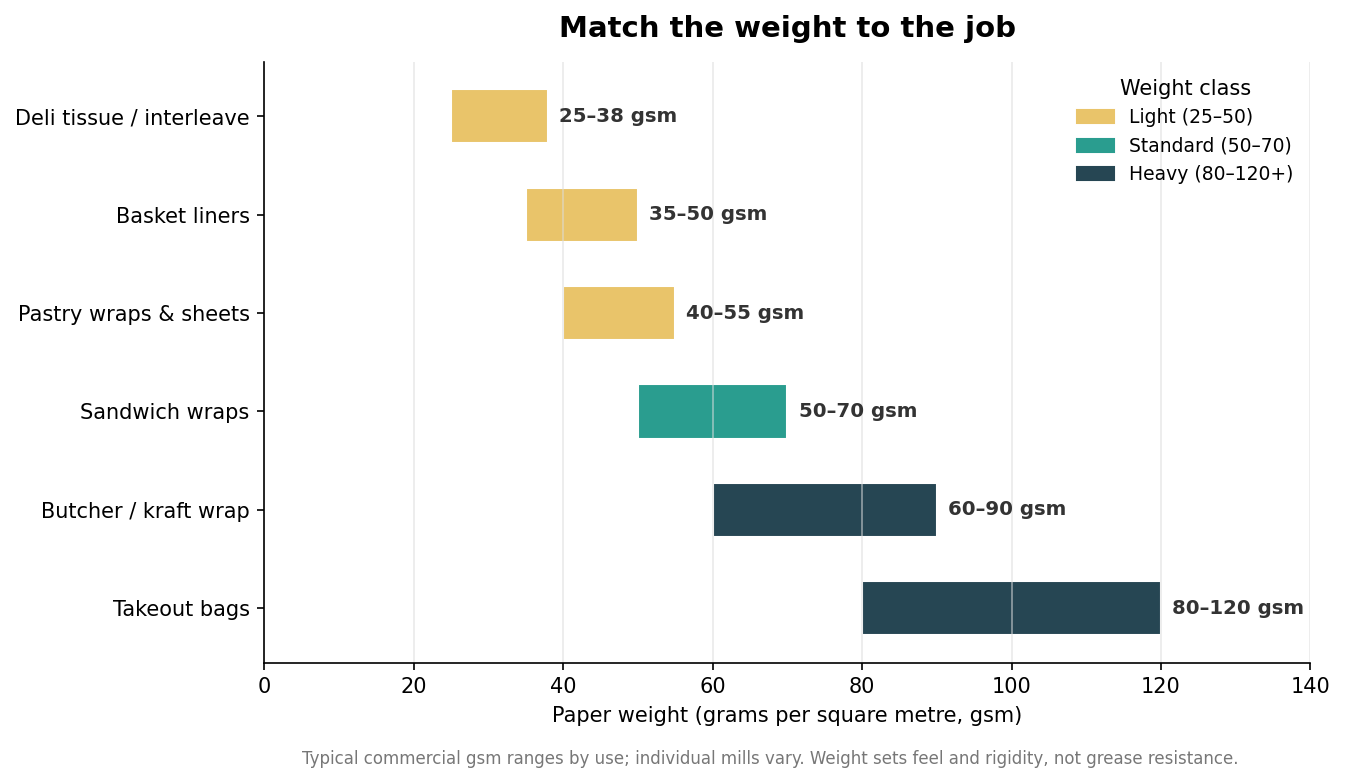
The pattern is intuitive once you see it laid out: the more a sheet has to physically hold, fold around, or carry, the heavier it goes. A useful shorthand is to think in three bands — light stock under 50 gsm for lining and separating, a standard 50 to 70 gsm for wrapping, and heavy 80 gsm-plus for structural jobs. Land in the right band first, then fine-tune within it based on how the paper feels in your hand.
The mistake: weight is not grease resistance
Here is the trap that catches more buyers than any other. It is easy to assume that a heavier, thicker-feeling sheet must resist grease better — and it is simply not true. Grease resistance comes from the barrier: a coating or a densely refined fiber structure that oil cannot penetrate, measured on a separate scale (the Kit level). Weight comes from how much fiber is in the sheet. The two are set independently at the mill. A heavy, substantial-feeling sheet with no barrier treatment will soak through with oil just as fast as flimsy paper, and a light, thin sheet with a good barrier can shrug off a greasy fry for the whole meal.
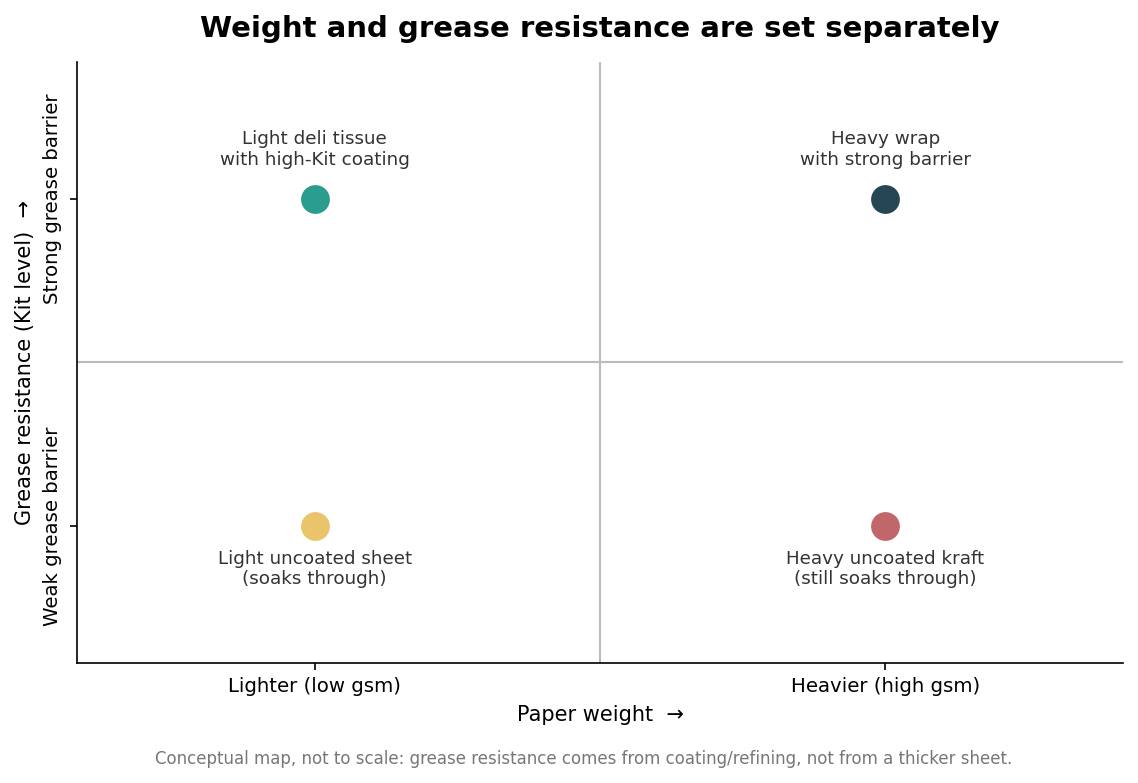
Specify the two things separately. Choose the weight for the physical job — how the sheet needs to feel and fold — and choose the grease barrier for the food — how oily it is and how long it has to sit. If you only tell a supplier “make it heavy so it doesn’t soak through,” you may get a stiff sheet that still fails, because you asked the wrong specification to do the barrier’s job. Knowing that these are two different knobs is the single most useful thing on this page.
What heavier paper buys you, and what it costs
Assuming the barrier is handled, going heavier does buy real things: more rigidity, better tear resistance, and a more premium hand-feel that signals quality when a customer unwraps their order. That is why a sit-down burger joint might choose a substantial kraft wrap while a bakery reaches for a light tissue. But weight is not free. More grams per sheet means more raw material per sheet, so heavier stock generally costs more per piece and adds up across a large run. It also means more weight per case, which raises freight, and fewer sheets in the same storage footprint. And past a point, extra weight actively hurts: a stiff sheet won’t drape cleanly around a soft item or fold into a neat sandwich pocket. The goal is the lightest weight that still does the job confidently, not the heaviest you can justify.
Specifying weight on your order
When you place a custom order, name the gsm explicitly rather than describing the paper as “thick” or “sturdy,” which mean different things to different mills. Tell the supplier the application — deli sheet, basket liner, sandwich wrap, takeout bag — and either the exact gsm or the weight band you want, and pair it with the grease barrier the food requires. If you are unsure, ask for a sample swatch at two adjacent weights and handle them before committing, since the difference between, say, a 50 and a 60 gsm wrap is easy to feel and hard to picture from a number. Getting the weight right on the front end means your printed paper looks the part, behaves the way your staff expect at the counter, and doesn’t cost you a cent more than the job actually needs.
Leave a Reply