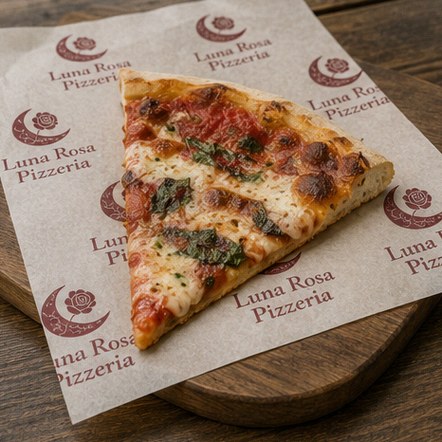
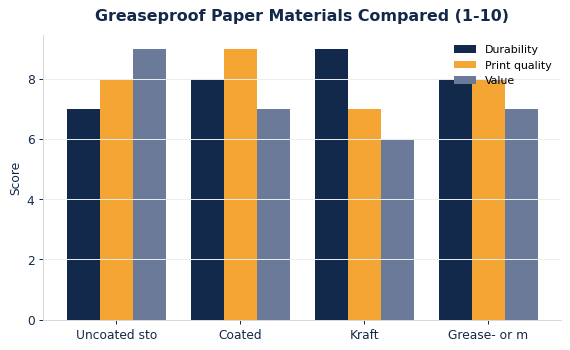
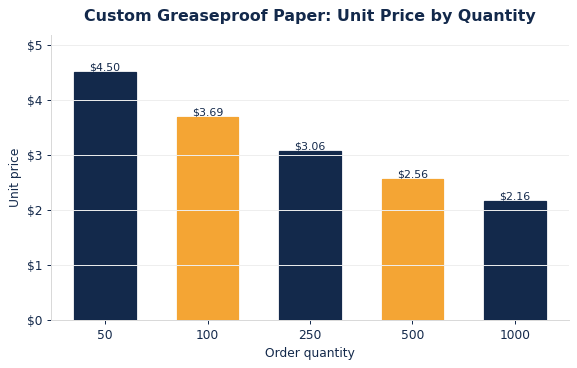
The best artwork for custom greaseproof paper is a vector logo, set in colors chosen for the actual paper, placed where folds and food will not hide it. Customized Greaseproof Paper turns your file into a free mockup within 24 hours, so you can check spelling, colors and placement on the real sheet format before anything prints.
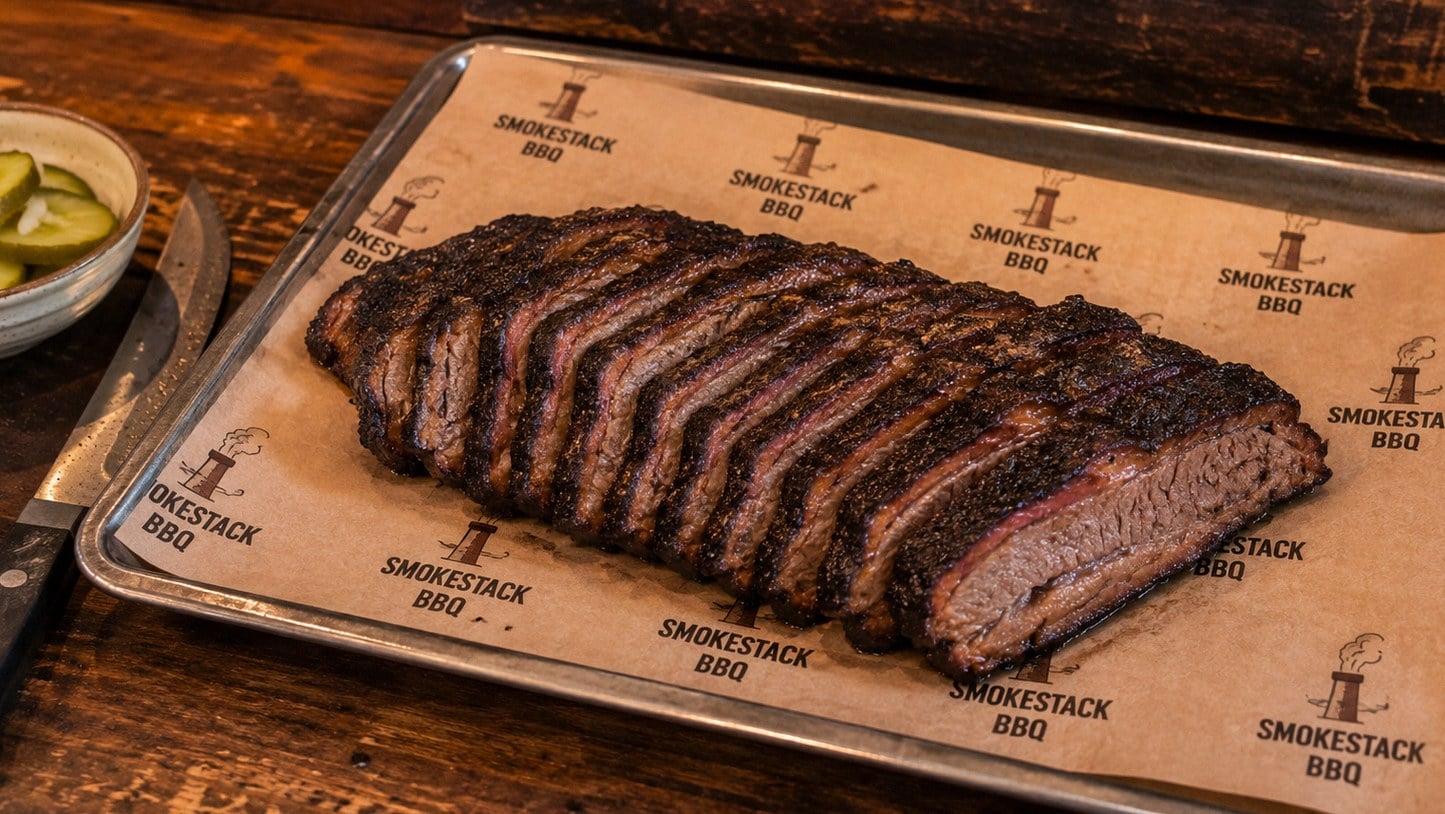
- Vector files (AI, EPS, SVG, PDF) print sharpest on greaseproof paper
- Light ink colors fade on kraft; white stock matches brand colors most closely
- Free mockup within 24 hours with unlimited free revisions
- Pay nothing until you approve the design
- Minimum order 12; standard production about 2 weeks
What artwork file works best for custom greaseproof paper?
The best artwork file for custom greaseproof paper is a vector file: an AI, EPS, SVG or a PDF saved from a design program with the logo still editable. Vector art scales from a small corner mark on a fry scoop sheet to a large center logo on a deli wrap without going soft, and it lets Customized Greaseproof Paper separate your colors cleanly for print.
A high-resolution PNG or JPG can still work when it is the only file you have. The rule is simple: the image should look sharp when you zoom in on your screen at the size it will print. If the edges of letters look fuzzy or stair-stepped at that size, they will look the same way on the sheet, and grease paper is not forgiving because the logo sits right next to the food.
If you only have a logo pulled from your website, a social profile or a photo of your sign, send it anyway. Customized Greaseproof Paper can tell you whether it will print well and, where it is simple enough, rebuild it as part of the free mockup. Typical files that cause trouble:
- Screenshots and images copied from social media, which are usually too small.
- Logos embedded inside a Word document or a slide deck.
- Artwork with a colored box behind the logo that was never meant to print.
- Fonts that were not converted to outlines, which can swap to a default typeface.
How do ink colors look on white versus kraft greaseproof paper?
Ink colors on greaseproof paper look brightest and most true to your brand guide on white stock, and warmer, softer and slightly darker on natural kraft. Printing inks are not opaque paint, so the color of the paper shows through. A bright yellow that pops on white can look muted or olive on kraft, while black, deep red and dark green hold up well on both.
Choose the paper first, then judge your colors on that paper. If your brand relies on one exact shade, white greaseproof paper is the safer choice. If you want a rustic, deli or butcher-shop look, kraft carries one or two strong colors beautifully and hides small color shifts.
| Design element | White greaseproof paper | Kraft greaseproof paper |
|---|---|---|
| Brand colors | Closest match to your brand guide | Warmer and darker; light colors fade |
| Black and dark inks | Crisp and high contrast | Strong and readable |
| Pastels and light tints | Visible but soft | Often too faint to read |
| White ink areas | Not needed; paper is the white | Not a substitute for a white background |
| Best overall look | Clean, modern, colorful | Natural, artisan, old-school deli |
The full-color printed parchment option suits detailed, multi-color artwork, while one- and two-color logos work across every style on the site.
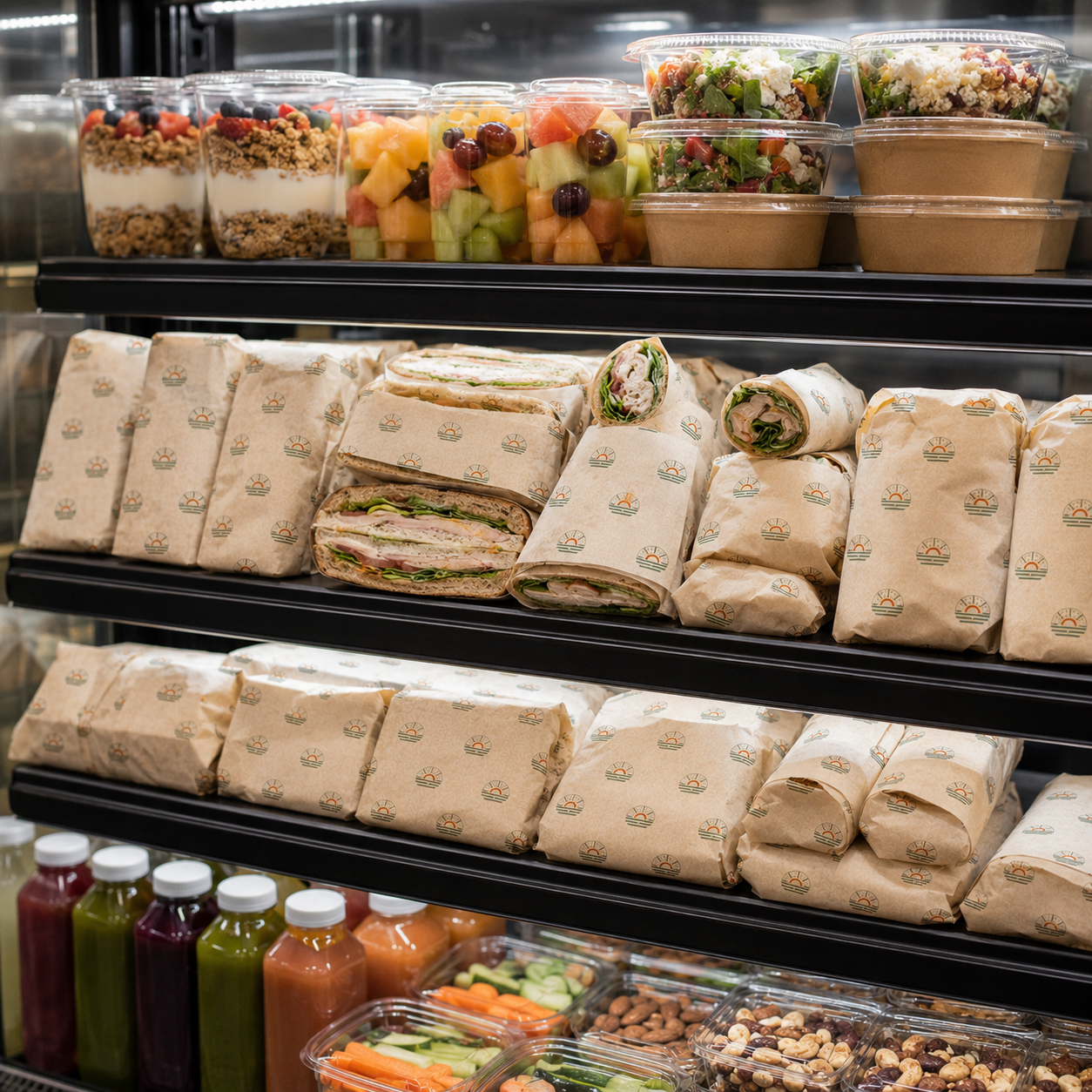
Should I use a single logo, a repeat pattern or an all-over design on greaseproof paper?
For most restaurants, a repeat pattern is the safest layout for custom greaseproof paper, because the sheet gets folded, wrapped and torn and your logo still shows from every angle. A single centered logo looks great flat in a basket but can disappear inside a folded burger wrap. An all-over design makes the boldest statement but needs simple, strong artwork to avoid looking busy next to food.
| Layout | Works best for | Watch out for |
|---|---|---|
| Single logo | Basket and tray liners that stay flat | Logo lost when the sheet is folded |
| Corner or edge logo | Fry scoops and snack sheets | Mark landing on the fold line |
| Repeat pattern | Sandwich, burger and deli wraps | Spacing so logos do not crowd each other |
| All-over design | Checkerboard, newsprint or illustrated looks | Busy art competing with the food |
Think about how your staff will use the sheet. If the sheet wraps a sandwich, picture the finished package from the outside. If it lines a basket, picture it with fries piled on the middle. Our deli and sandwich wrap sheets and basket and tray liners pages show how each format is typically used, which helps you place the art where guests will actually see it.
How does food contact change the way greaseproof paper artwork reads?
Food covers part of every custom greaseproof paper sheet, so the artwork has to work with the middle hidden. Fries, burgers and pastries sit in the center, and sauce or oil can make the paper look darker or slightly see-through where food rests. Designs that place important text at the edges and in repeating positions keep reading clearly through the whole meal.
A few habits help artwork survive real service:
- Keep small text out of the center. Hours, web addresses and social handles belong near the edges, where food rarely sits.
- Use bold shapes over fine detail. Hairline strokes and tiny lettering get lost on textured paper and under crumbs.
- Repeat the key message. If your handle or name matters, print it more than once so at least one copy stays visible.
- Leave breathing room around the logo. A clear zone around the mark keeps it from blending into a pattern.
The mockup from Customized Greaseproof Paper shows your art on the actual sheet size you chose, so you can judge whether the logo still reads with a burger or a pile of fries in the middle before anything is printed.
What should I check on the greaseproof paper mockup before approving it?
Before approving a custom greaseproof paper mockup, check spelling, colors, sheet size, logo placement and how the design looks once folded. Customized Greaseproof Paper sends a free mockup within 24 hours of your request and offers unlimited free revisions, and you pay nothing until you approve the design. That makes the proof stage the cheapest place to catch a mistake.
- Read every word out loud. Business name, street address, phone number, web address and social handle are where typos hide.
- Confirm the paper. Make sure the mockup shows the white or kraft stock you want, because colors shift between them.
- Confirm the sheet format. Check that the size matches your baskets, trays or wrap style.
- Check placement. Picture the sheet folded or covered with food and confirm the logo still shows.
- Compare colors to your brand. Screens vary, so compare against your printed menu or signage rather than another monitor.
- Ask a second person. A fresh pair of eyes catches what you have stopped seeing.
Once you approve, standard production takes about 2 weeks, with faster turnaround available through express shipping. Changes after approval are much harder to make, so take the extra hour at this step.
What are the most common artwork mistakes on custom greaseproof paper?
The most common artwork mistakes on custom greaseproof paper are low-resolution logos, colors chosen on screen instead of on the actual paper, text that is too small, and designs that ignore folding. Every one of them is easy to fix at the mockup stage and frustrating to discover after the sheets arrive in your kitchen.
- Printing a website logo. Logos saved for web pages are usually too small for a full sheet.
- Light colors on kraft. Pale yellows, pinks and grays can nearly vanish on brown paper.
- Too much information. A full menu, address, hours and a slogan crowd the sheet; pick one or two messages.
- Ignoring the fold. A logo that lands right on the fold of a wrap or scoop gets split in half.
- Old contact details. A previous phone number or closed location will be printed on every sheet in the run.
- Skipping the second reviewer. One approver means one set of eyes on spelling.
If you are unsure about any of these, mention it when you request your quote. Customized Greaseproof Paper will flag issues it spots in the mockup, but nobody knows your current hours and handles better than you do.
How do I send artwork to Customized Greaseproof Paper?
Send artwork to Customized Greaseproof Paper through the custom quote form, along with the paper style, sheet format and quantity you have in mind. The minimum order is 12, so a small trial run for a pop-up or a new menu item is possible, and larger runs work the same way.
Helpful details to include with your file:
- Which product you want, such as custom greaseproof paper wraps, fry scoop and snack sheets or bakery tissue sheets.
- White or kraft paper, or a note asking for a recommendation.
- Your brand colors, by name or from your brand guide.
- Single logo, repeat pattern or all-over layout.
- The date you need the sheets in the kitchen.
From there, the how it works steps are short: mockup within 24 hours, revisions until you are happy, approval, then about 2 weeks of production. Burger concepts can also see format ideas on the burger restaurant page.
Frequently asked questions
Can a hand-drawn logo be printed on custom greaseproof paper?
Custom greaseproof paper can carry a hand-drawn logo once the drawing is turned into clean digital artwork. A clear, well-lit scan or photo of the sketch on plain white paper is the best starting point. Customized Greaseproof Paper can review the image and advise whether it is ready to print or needs to be redrawn before the mockup.
Will a gradient or photo in my logo print well on greaseproof paper?
Greaseproof paper can show gradients and photographic detail when printed in full color, but subtle fades and fine shading look softer than on glossy stock. Bold shapes and solid colors read more clearly next to food. If your logo depends on a gradient, ask for a mockup that shows both the full-color version and a simplified solid version.
How many ink colors should a greaseproof paper design use?
Greaseproof paper designs usually look best with one or two strong ink colors, especially on kraft stock where light shades fade. Full-color artwork is possible for detailed or illustrated designs. Customized Greaseproof Paper can show how your logo looks in a reduced palette so you can compare it with the full-color version before approving.
Can greaseproof paper artwork include a QR code?
Greaseproof paper can carry a QR code, but the code needs to be printed large, in a dark color and with a clear border so phones can scan it on textured paper. Place it near an edge where food will not cover it. Customized Greaseproof Paper shows the code on the mockup so you can test-scan it before approving.
Does the greaseproof paper design need to account for folding?
Greaseproof paper designs for wraps and fry scoops should always account for folding, because a logo placed on the fold line gets split or hidden. Repeat patterns and corner marks avoid that problem. When you request a mockup, tell Customized Greaseproof Paper how your staff folds the sheet so placement can be planned around it.
Can my graphic designer work directly with Customized Greaseproof Paper on the artwork?
Greaseproof paper artwork often moves faster when your designer is involved, because questions about files, fonts and colors get answered by the person who made the logo. Customized Greaseproof Paper can send the mockup to you and your designer together, and every revision round stays free until you approve the final design.
What happens if my greaseproof paper artwork is too low resolution?
Greaseproof paper printed from low-resolution artwork shows fuzzy edges and blurred lettering, which stands out right next to food. Customized Greaseproof Paper checks files before the mockup and will let you know if an image is too small. Often a simple logo can be redrawn, or your designer can supply a vector version.
What brand guide details help a greaseproof paper mockup come out right?
Greaseproof paper mockups come out closest to your brand when you share your logo file, color names or codes from your brand guide, approved fonts and any rules about spacing around the logo. Examples of your current menu, cups or signage also help. Customized Greaseproof Paper uses those references to match the sheet to the rest of your packaging.
Should kraft greaseproof paper artwork be designed differently from white?
Kraft greaseproof paper artwork should use darker, stronger colors than artwork for white stock, because the brown paper shows through the ink and mutes light shades. Black, deep reds, navy and forest green read clearly on kraft. Customized Greaseproof Paper can mock up the same logo on both papers so you can compare them.
Who owns the greaseproof paper artwork after it is set up for printing?
Greaseproof paper artwork built from your logo remains your brand, and keeping your own original logo files is always a good idea. Ask Customized Greaseproof Paper to keep your approved design on file so a reorder of the same greaseproof paper sheets does not require starting the artwork process over from the beginning.
Can a greaseproof paper design be updated between reorders?
Greaseproof paper designs can be changed between reorders, whether you are updating a phone number, adding a new location or refreshing the whole look. A changed design gets a new free mockup within 24 hours and unlimited revisions, and you pay nothing until you approve it, so small updates are easy to manage.
Get a free mockup for your greaseproof paper
Send your logo or idea and the quantity you have in mind. Customized Greaseproof Paper returns a free mockup within 24 hours, you approve the design before anything is produced, and standard turnaround is about two weeks with faster options available. Get a custom quote.